This is it. The big idea. What if I took Lamentations of the Flame Princess, and plonked it in an Early Modern setting? Original, right? Again, see the blog tagline (and Tim, if by any small chance you read this, thanks for running a great campaign and planting these seeds). Anyhow, here's the plan: Lamentations of the Flame Princess set at some point in the reign of Elizabeth I (1559-1603), with the possibility of continuing into the Stuart era after that. There are several areas that need to be considered for such a real world setting:
- Key events and dates
- Key personages
- Society and technology
In addition there are the usual fantastical elements to consider:
- The 'true' nature of gods/deities
- Magic
- Weird and wonderful creatures, and demihumans
Disclaimer: I am not a historian, I am an enthused amateur with access to Wikipedia.
So without further ado...
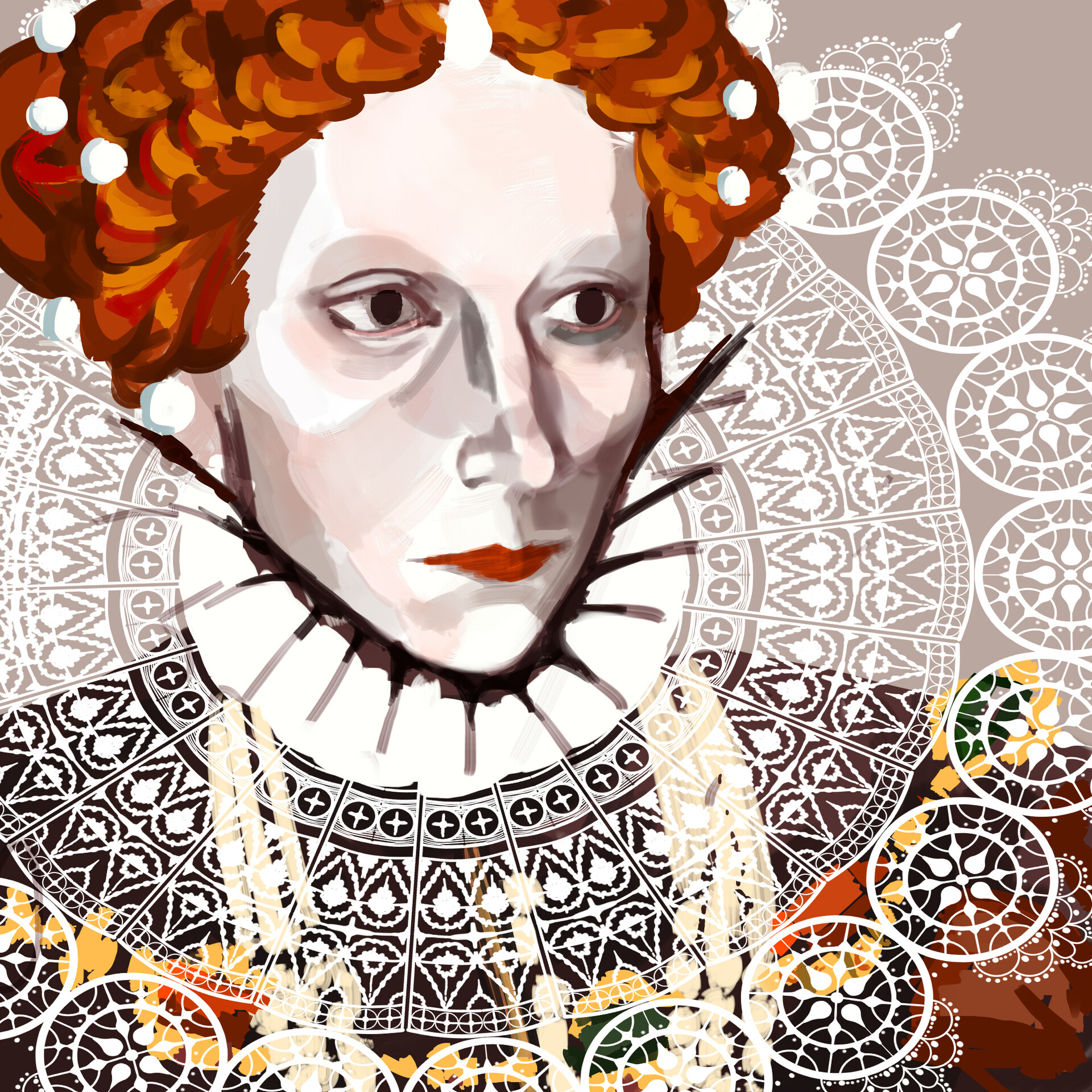 |
| Sushkin |
Key events and dates
This is a general list of key dates relating to important people, places and things focused on the Kingdom of England in this time period. At this point England was very much in the opening stages of building what would eventually become the British Empire - Columbus' final journey had only taken place some 50 years past, and the survivors of Magellan's circumnavigation returned to Spain only a couple of decades after that. At the start of Elizabeth's reign England's main overseas possessions were a series of Plantations in Ireland (Calais having been lost shortly before Elizabeth ascended the throne) but by the turn of the 17th century two English colonies had failed in North America (I like to refer to them as 'Roanoke: Population 0' and 'Roanoke II: Starvation Boogaloo'), colonies had been established in Jamestown and Bermuda, the East India Company had gained its first footholds in Asia, and the colonisation of Ireland really took off.
As such, while England was by no means a stranger to brutal overseas exploitation most of this was conducted somewhat closer to home than during the mainstream imperial period (although the people of Ireland were continually treated despicably and at times genocidally so). European opposition to England in this period came largely from the Spanish Empire under Philip II as France (England's bitter rival for most of however long the two polities have existed) was embroiled in internal religious strife which left it inward-facing. Scotland, the traditional ally of France, likewise maintained reasonably peaceful relations with England throughout Elizabeth's reign (at least when compared to Elizabeth's father, Henry VIII) and was largely concerned with a similar internal tension between Protestant and Catholic factions as found in England. The Low Countries were a staunch ally of England in the latter part of the era, with Elizabeth supporting the Dutch Protestants in rebelling against their Spanish overlords.
Internally, England was riven with the divisions that arose out of the Reformation and counter-Reformation. This led to open rebellion early in her reign and a number of plots and intrigues that prompted Elizabeth to execute her imprisoned cousin (who had already been forced to abdicate the Scottish throne by a faction of Protestant nobles) and stage a harsh crackdown on Catholicism. At the same time efforts were made to mend the rift between not only Catholics and Protestants, but between conservative Protestants (who supported the Anglican Church) and more radical groups like the Puritans - a settlement was gradually enacted which attempted to include elements of Catholic ritual and symbolism in a 'high church' style while also allowing greater leeway in personal belief regarding certain Christian sacraments and ensuring the Church's independence from the Papacy. It was a decidedly spit and duct-tape solution that remained in place until the Puritan-dominated Parliamentarians dismantled the settlement during the Wars of the Three Kingdoms, only for it to be reintroduced with renewed vigour after the restoration of the monarchy following Cromwell's death in the 17th century. A combination of Catholic-Protestant conflict and England's early colonial ambitions in Ireland lead to probably the largest cause of internal conflict in the Nine Years' War where Irish lords fought against English incursions into Ulster and their initial success led to other Irish lords joining them, notbaly in Munster. While the prospect of an initially successful pseudo-rebellion* was disturbing in and of itself, the actions of the Earl of Essex (Elizabeth's favourite at court) in the Irish campaign led to him attempting a coup in London.
*The Irish lords were native Irish chiefs, the Crown only really controlled the Pale and the Anglo-Irish lordships that owed them fealty were often tenuous and prone to revolt - the English occupation of Ireland from the Normans onwards ebbed and flowed in its intensity before the Plantations and Cromwell's genocidal conquest finally cemented English control over the country.
With the above in mind I've prepared a short summary of what I find to be key dates in Elizabethan England, showcasing events relating to internal intrigues, wars and important battles, and important events and accomplishments. The idea being that these provide 'beats' in a campaign to focus certain adventures around or to just affect the flow of the game and the overall setting:
- 1559 - Elizabeth I crowned Queen of England.
- 1560 - Elizabeth charters the 'Sea Dogs' with letters of marque to prey upon Spanish shipping in the Caribbean.
- 1562 - English privateers first recorded taking people as slaves in what is now Sierra Leone and pioneering the Atlantic slave trade in England.
- 1567 - Mary, Queen of Scots, is forced to abdicate the Scottish throne in favour of her infant son, James VI.
- 1569 - The Rising of the North - Northern English Catholic lords rebel against the Crown in favour of Mary, Queen of Scots.
- 1576 - Martin Frobisher begins expeditions in search of the North-West Passage.
- 1577 - Drake’s Circumnavigation.
- 1583 - James VI of Scotland freed from captivity in Ruthven Castle. The young king begins to solidify his authority among the Scottish nobility. European ships, often fishermem, are known to gather at the site of modern St. Johns in Newfoundland, though no permanent settlement occurred.
- 1585 - Outbreak of Elizabethan War with Spain. Three ‘Cautionary Towns’ occupied by English troops in the Netherlands. Roanoke colony founded.
- 1586 - Babington Plot foiled by Sir Francis Walsingham, harsh crackdown on Catholicism. Treaty of Berwick signed between England and Scotland, officialy declaring peace between them. Roanoke colony abandoned, survivors introduce maize, tobacco and potatoes to the British Isles.
- 1587 - Execution of Mary, Queen of Scots. Second Roanoke colony founded in the Chesapeake Bay.
- 1588 - Defeat of the Spanish Armada.
- 1589 - English Armada fails to stir a Portuguese uprising and is defeated.
- 1590 - The North Berwick Witch Trials take place in Scotland, sparking off a craze which sees 3,000-4,000 people burned at the stake over the next few decades. Second Roanoke colony discovered abandoned.
- 1593 - Beginning of the Nine Years’ War in Ireland - Hugh O’Neill and Hugh Roe O’Donnell rebel against the English Crown.
- 1594 - Walter Raleigh’s expedition to find El Dorado sets sail.
- 1595 - Irish victory at the Battle of Clontibret.
- 1596 - English and Dutch forces capture and sack Cadiz. Second Spanish Armada falters in storms. The Spanish Crown is bankrupted by the cost of the failure.
- 1597 - Third Spanish Armada falters in storms.
- 1598 - Irish rebels win a major victory at the Battle of the Yellow Ford. Philip II dies.
- 1599 - Globe theatre constructed in Southwark.
- 1600 - East India Company chartered by Elizabeth I.
- 1601 - Earl of Essex attempts a coup d’etat at court, fails, and is executed.
- 1602 - Major English victory at the Siege of Kinsale.
- 1603 - Death of Elizabeth I and ending of the Tudor dynasty. James VI of Scotland is crowned James I of England, beginning the Stuart dynasty. End of the Nine Years’ War in Ireland with the Treaty of Mellifont.
- 1606 - Private Plantations of Ulster begin.
- 1607 - Jamestown colony established in Virginia.
- 1609 - Official Plantations of Ulster begin. Eighty percent of Jamestown colonists die of disease and starvation.


