Showing posts with label Adrift on the Night's Black Sea. Show all posts

Saturday, 1 September 2018

Adrift on the Night's Black Sea: Equipment Tags

In my previous post I mentioned that all weapons will deal 1d8 damage in line with the Eldritch Cock playtest rules. Instead of variable damage weapons in Adrift on the Night's Black Sea will feature different tags that alter their abilities and effects. Tags can also be applied to armour and other bits of equipment. Both positive and negative tags will be featured, though negative tags will normally be applied to weapons that have been improvised, scavenged or experimentally produced. My goals for this system are as follows:
  1. Simple - a tag will sum up the effect it has in a sentence or two. This can potentially link to other systems - if I ever publish this I will ensure links and references are included.
  2. Evocative - a tag's name will evoke a good sense of its effects, i.e. Irradiating, Fragile, Rending etc.
  3. Flexible - a PC should be able to apply and remove different tags to their equipment given the right resources, customising their kit to suit their needs.
I also planned to talk about the injury system I'll be using, as well as an outline of the psionics system that I've been mulling over, but this post became far too long.

Credit, Don Davis @ NASA Ames Research Centre

Equipment & Tags

A tag may only be taken once per equipment item unless otherwise specified.

Weapons

Weapons will have a certain number of innate tags, their size for example, that cannot be changed. These tags are determined at the creation of the weapon and are usually integral to their construction or function. A weapon's size will also determine how many tags it can have applied to it. Below is a set of base weapons for each size category. Below that is a list of further tags that can be applied, their restrictions, and list of weapons that I have come up with.

IMPORTANT: These are all still a work in progress and will more than likely be changed!

Base Melee Weapons

WeaponSizeInnate TagsFurther Tag Slots
Small WeaponSmallSmall - can be used while grappling.
1
Medium Weapon*MediumMedium - can be wielded in both hands for +1 damage.
2
Large Weapon**LargeLarge - must be wielded in 2 hands.
3

*Spears count as medium weapons and have their stock advantages/disadvantages as per core LotFP.
**Polearms count as large weapons and have their stock advantages/disadvantages as per core LotFP.


Base Ranged Weapons


WeaponSizeInnate TagsFurther Tag Slots
PistolSmallPistol - can be used in melee combat.
1
Rifle*MediumRifle - can be used as a melee weapon with -2 to hit.
2
Heavy WeaponLargeHeavy - takes a full round action to fire.
3
Bow**MediumSilent - makes no sound when fired.
2
Grenade Template***SmallThrown - this weapon is designed to be thrown at a target.
2

*This category covers rifles, shotguns, carbines and other two-handed firearms that don't qualify as heavy weapons.
**Note that bows will have access to a relatively small number of tags, but arrows may have one tag applied to them to allow for a number of different types.
***Grenades can be modified for different purposes, for example armour piercing grenades using the blast + hypervelocity tags, or a tear gas grenade using the gas + toxin tags. Rocket/grenade launchers are simply used for delivery purposes and have no tags of their own.

Reloading
After attacking with a ranged weapon, the wielder must roll to see if it needs reloading. To test this, roll 1d10. On a 1 the weapon must be reloaded. Bows and grenades do not make reload checks.

Further Weapon Tags
  • Autoloading (non-bow ranged only) - sophisticated ammunition feeders mean reloading this weapon counts as a minor action instead of a regular action.
  • Balanced (melee only) - this weapon is perfectly balanced for dual-wielding, increasing AC and hit bonuses to +2 when dual-wielding, or +1 if a large weapon. If both weapons are balanced this increases to +3.
  • Beam (non-grenade ranged only) - this weapon fires an energised beam or charge and its attacks have +2 to hit but can be impaired by thick smoke or dust clouds. This weapon uses power cells instead of projectile ammo - make all reload rolls with advantage.
  • Blast (grenades only) - this weapon unleashes an indiscriminate explosion that attacks AC12 or the target's base AC, whichever is lower. The weapon is irrevocably destroyed once used.
  • Cryogenic (non-bow, non-hyperthermic) - shots from this weapon chill and numb their targets. The target must Save on a successful hit or be slowed for 1d6 Rounds.
  • Energised (melee only) - this weapon is surrounded in a crackling halo of energy, gaining +2 to hit and damage rolls.
  • Gas (non-bow, non-beam ranged only) - this weapon projects a gas instead of a solid or energy projectile. While it has a short range this gas spreads quickly and bypasses most forms of armour and cover, taking +4 to hit.
  • Hyperthermic (non-bow, non-cryogenic) - this weapon superheats its targets. The target must Save on a successful hit or begin burning (see Injuries section).
  • Hypervelocity (non-beam ranged only) - this weapon fires solid ammunition with terrifying power, gaining +2 to damage. Enemies behind cover take no AC bonus when targeted by this weapon.
  • Ionic (non-bow) - this weapon is electrically charged and only deals 1d4 damage to organic targets, but artificial targets take double damage. Any artificial or cybernetically-enhanced target must also Save when hit or be stunned for 1d6 Rounds.
  • Irradiating (non-bow) - this weapon emits harmful levels of ionising radiation. The target must Save on a successful hit or suffer +2Gy cumulative rad exposure (see Injuries section).
  • Jet (non-bow, non-beam ranged only) - this weapon projects a liquid instead of a solid or energy projectile. This weapon has a moderate range and takes +2 to hit.
  • Lightweight - this weapon is non-encumbering, or counts as a normal item if oversized.
  • Needler (non-beam, non-bow ranged only) - this weapon fires needle-like solid projectils at a high rate of fire with very little recoil. This weapon takes +4 on hit rolls but deals 1d4 damage instead of 1d8.
  • Rapid Fire (non-bow ranged only) - this weapon has a terrifying rate of fire and rolls to hit and damage with advantage, but reload rolls are made with disadvantage. This weapon can suppress targets instead of directly attacking, who must Save or take disadvantage on their next attack roll.
  • Rending (non-bow) - this weapon slices and tears flesh with ease. The target must Save on a successful hit or begin bleeding (see Injuries section).
  • Scattershot (non-blast ranged only) - this weapon fires multiple projectiles with a single shot, allowing the wielder to attack 2 adjacent targets with their normal combat bonus but dealing half damage to each (roll once and divide by 2, minimum 1 damage each).
  • Silent (non-blast only) - attacks with this weapon make very little to no sound.
  • Thrown - this weapon is designed to be thrown at a target.
  • Toxic - this weapon delivers a specific poison or disease to its target. The target must Save or suffer the effects (see Injuries section).
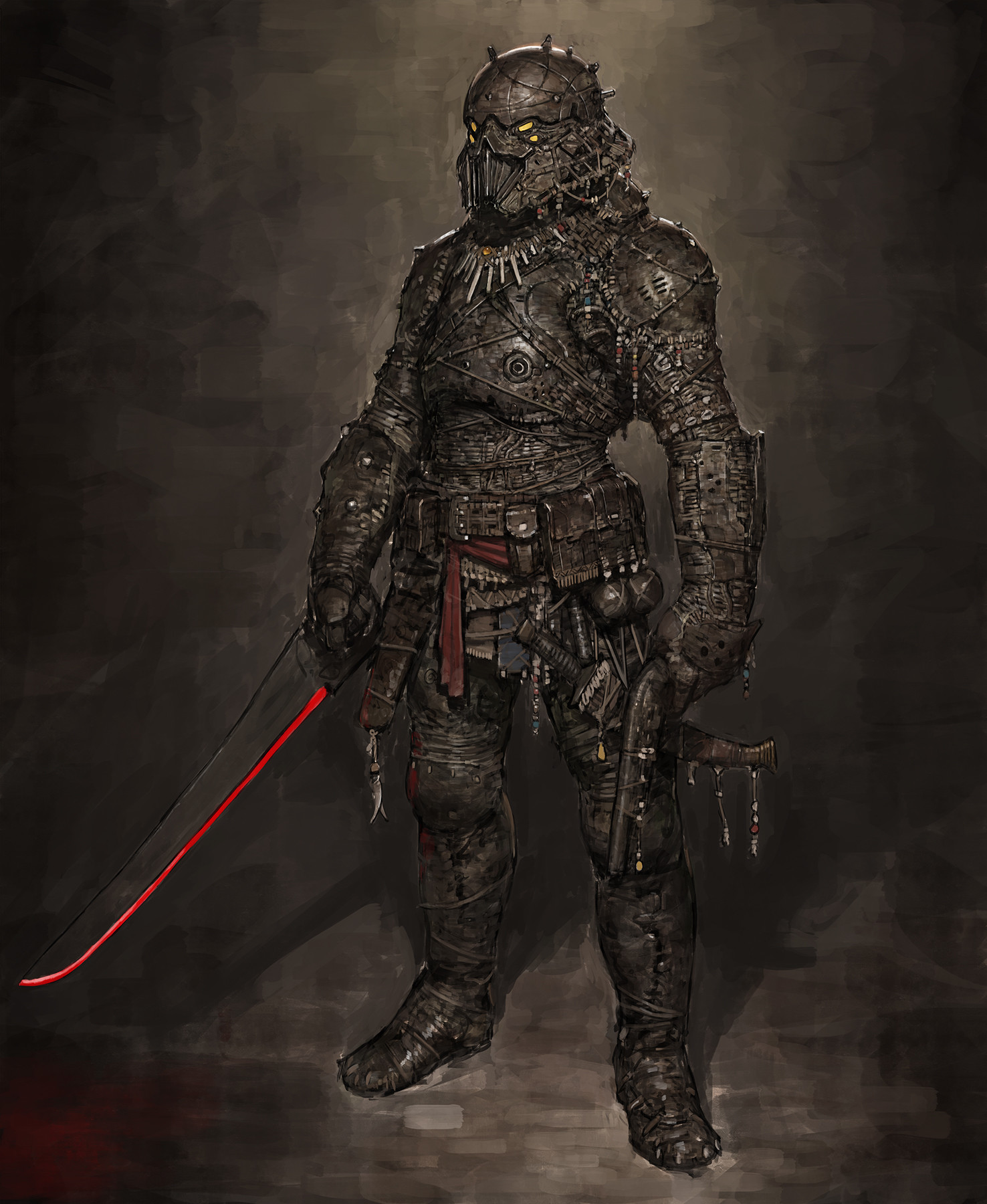
Credit, Ariel Perez

Armour

Armour, unlike weapons, will not have innate tags. I found it hard to think up things that weren't otherwise explained elsewhere in the LotFP rules (like encumbrance and so on) so I thought it best to leave them blank. However it will still be possible to modify armour to add and remove tags.

Base Armour


ArmourBase ACTag Slots
Light Armour
 14
2
Medium Armour
 16
3
Heavy Armour
 18
4
Shield
 +2
1

Armour Tags
  • Ablative - this armour is layered with materials that divert shock and energy by vaporising or fragmenting. The first time the wearer of this armour would suffer weapon damage*, instead negate the damage and remove this tag. This tag can be taken multiple times.
  • Active Countermeasures - this armour has close-in weapon capability and can intercept grenades and other thrown or slow-moving missiles. When the wearer of this armour is targeted by a thrown weapon or arrow, or if a grenade or rocket would impact within 10', they may Save as a free action to intercept it before it impacts.
  • Autosenses - this armour holds integrated sensors and scanners. The wearer of this armour can sense heat and electrical signatures within 100' (if not obscured), see up to 200' away in darkness, and sense the chemical composition of the surrounding atmosphere.
  • Chameleon - this armour has chameleon circuitry embedded within it, allowing the wearer to blend in to their surroundings. The wearer's Stealth skill counts as +4 while they keep perfectly still, and +2 while they are moving - every 2 points of damage suffered reduces the Stealth bonus by 1 until the armour is repaired.
  • Commlink - this armour has an in-built communicator and recording apparatus capable of broadcasting up to three times the range of a handheld communicator.
  • Exopowered - this armour contains layers of carbon-mesh muscle and steel sinew to enhance the strength of the wearer. The wearer of this armour counts their STR as 2 higher than normal.
  • Grav-stabilisers - internal gravitic fields and gyroscopic stabilisers allow the wearer of this armour to keep their balance in nearly all situations. The wearer makes all Climb rolls and combat manoeuvre rolls to stay upright with advantage, and suffers no penalty in zero-g.
  • Integrated Weaponry - this armour has an integrated melee or ranged weapon, up to medium or pistol size. The bearer cannot be disarmed of these weapons but they may not have additional tags beyond their base.
  • Kinetic Dampeners - gravitic dampeners and endurance fibres allow this armour to absorb shocks and gravitational forces. The wearer of this armour will take falling damage for every 20' fallen instead of 10' and makes Saves vs g-force with advantage.
  • Lightweight - this armour's encumbrance is reduced by 1, or counts as a normal item if oversized.
  • Psi-Scanner - built-in psionic sensors allow the wearer a greater sensitivity to psionics. The wearer of this armour is able to detect psionic energy and psions, as well as identifying the effects of detected psionic energy.
  • Psi-Warded - advanced materials, their method of construction long forgotten, line this armour and reduce the effect of psionic powers on the wearer. The wearer makes all Saves vs Psionics with advantage.
  • Rad-Shielded - this armour is specifically designed to resist harmful radiation levels. The wearer of this armour makes all Saves vs Radiation with advantage.
  • Radiators - this armour holds sophisticated cooling systems to vent excess heat. The wearer of this armour makes all Saves vs heat effects with advantage, but is still vulnerable to being set ablaze.
  • Smokescreen - as a move action this armour can emit billowing clouds of smoke to mask its wearer. The smoke reaches up to 50' away from the wearer and the armour's reservoirs must be reloaded before it can be used again.
  • Static Discharge - internal capacitors bleed off kinetic energy as a last-ditch defence mechanism. Any opponent who damages the wearer of this armour in melee must Save or suffer 1 damage from an electrical jolt.
  • Survival Filters - internal filtration and reprocessing symptoms allow the wearer to survive without food or water for double the normal duration. They'll smell awful afterwards though.
  • Thrusters - the wearer of this armour can jump up to three times their movement under normal gravity (which requires a Turn to cool the engines), or move at the normal movement rate with ease in zero-g.
  • Trauma Kit - internal life support systems allow this armour to keep its wearer alive in cases of grievous injury. If the wearer of this armour is injured to the point where they start dying this armour automatically stabilises them for 6 hours, after which they will die if they do not receive treatment.
  • Vacc-Sealed - this armour is sealed against the cold void, and is also impermeable to most airborne toxins and diseases. The internal air supply will last for 8 hours.
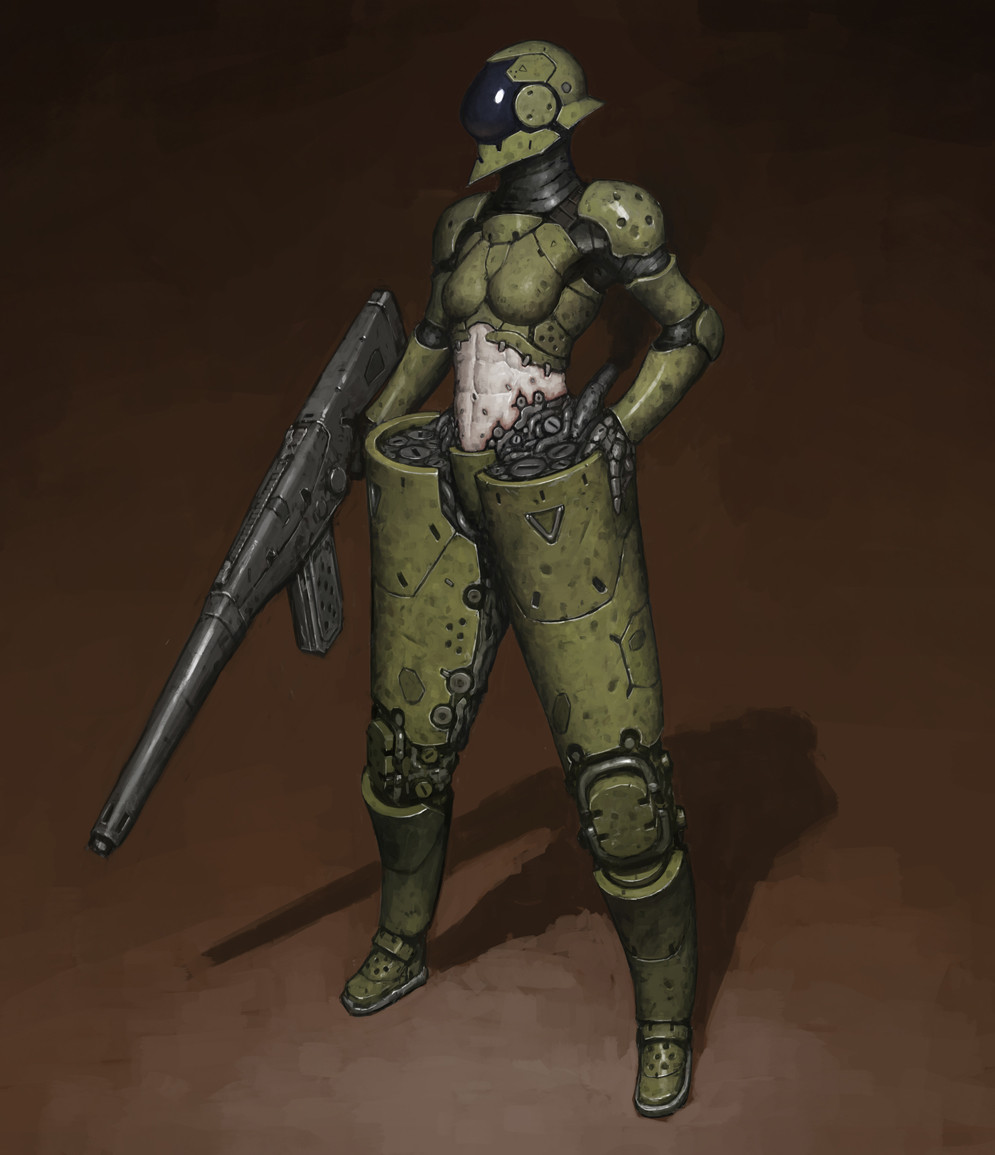
Credit, Ariel Perez

Examples

Here are a few things that I came up with using the above tags:

Ranged Weapons

Laser Pistol
Tags: pistol, beam.

Machine Pistol
Tags: pistol, rapid fire.

Silenced Pistol
Tags: pistol, silent.

Hypodermic Rifle
Tags: rifle, needler, toxic.

Combat Shotgun
Tags: rifle, autoloader, scattershot.

Survival Rifle
Tags: rifle, beam, lightweight.

Heavy Machine Gun
Tags: heavy, hypervelocity, rapid fire, scattershot.

Plasma Lance
Tags: heavy, beam, hyperthermic, rapid fire.

Cryo Cannon
Tags: heavy, cryogenic, jet, lightweight.


Melee Weapons

Charge Prod
Tags: small, ionic.

Assassin's Knife
Tags: small, toxic.

Parrying Dagger
Tags: small, balanced.

Duellist's Chainblade
Tags: medium, balanced, rending.

Hunter's Javelin
Tags: medium, balanced, thrown.

Phoenix Blade
Tags: medium, hyperthermic, lightweight.

Rad Axe
Tags: large, energised, irradiated, lightweight.

Ion Maul
Tags: large, energised, ionic, rending.

Void Lance
Tags: large, balanced, lightweight, silent.


Grenades

Frag Grenade
Tags: thrown, blast, scattershot.

Chokegas Bomb
Tags: thrown, gas, toxin.

Incendiary Grenade
Tags: thrown, blast, hyperthermic.

Rad Emitter
Tags: thrown, gas, irradiated.


Armour

Infiltration Gear (Light)
Tags: autosenses, chameleon. 

Loading Apparatus (Light)
Tags: exopowered, kinetic dampeners.

Stillsuit (Light)
Tags: commlink, survival filters.

Voidsuit (Medium)
Tags: grav-stabilisers, thrusters, vacc-sealed.

Gladiator Armour (Medium)
Tags: ablative, lightweight, static discharge.

Psi-Enforcer Gear (Medium)
Tags: commlink, psi-scanner psi-warded.

Juggernaut Armour (Heavy)
Tags: active countermeasures, autosenses, integrated weaponry, smokescreen.

Reactor Suit (Heavy)
Tags: commlink, rad-shielded, trauma kit, vacc-shielded.

Mining Gear (Heavy)
Tags: exopowered, lightweight, radiators, survival filters.

Friday, 24 August 2018

Adrift on the Night's Black Sea: Rules (Of A Sort)

A science-fantasy setting represents a fairly significant break from the implied 16th century Europe setting of stock Lamentations of the Flame Princess. This has led me to tweak and change a reasonable number of rules, which I'll detail below. Before I do, let me say that the playtest rules in Eldritch Cock are a fucking godsend that makes dealing with anything class-related much easier because I don't have to fuck around with separate hit dice, XP tracks and saving throws anymore. It's now much easier to focus on cool shit.

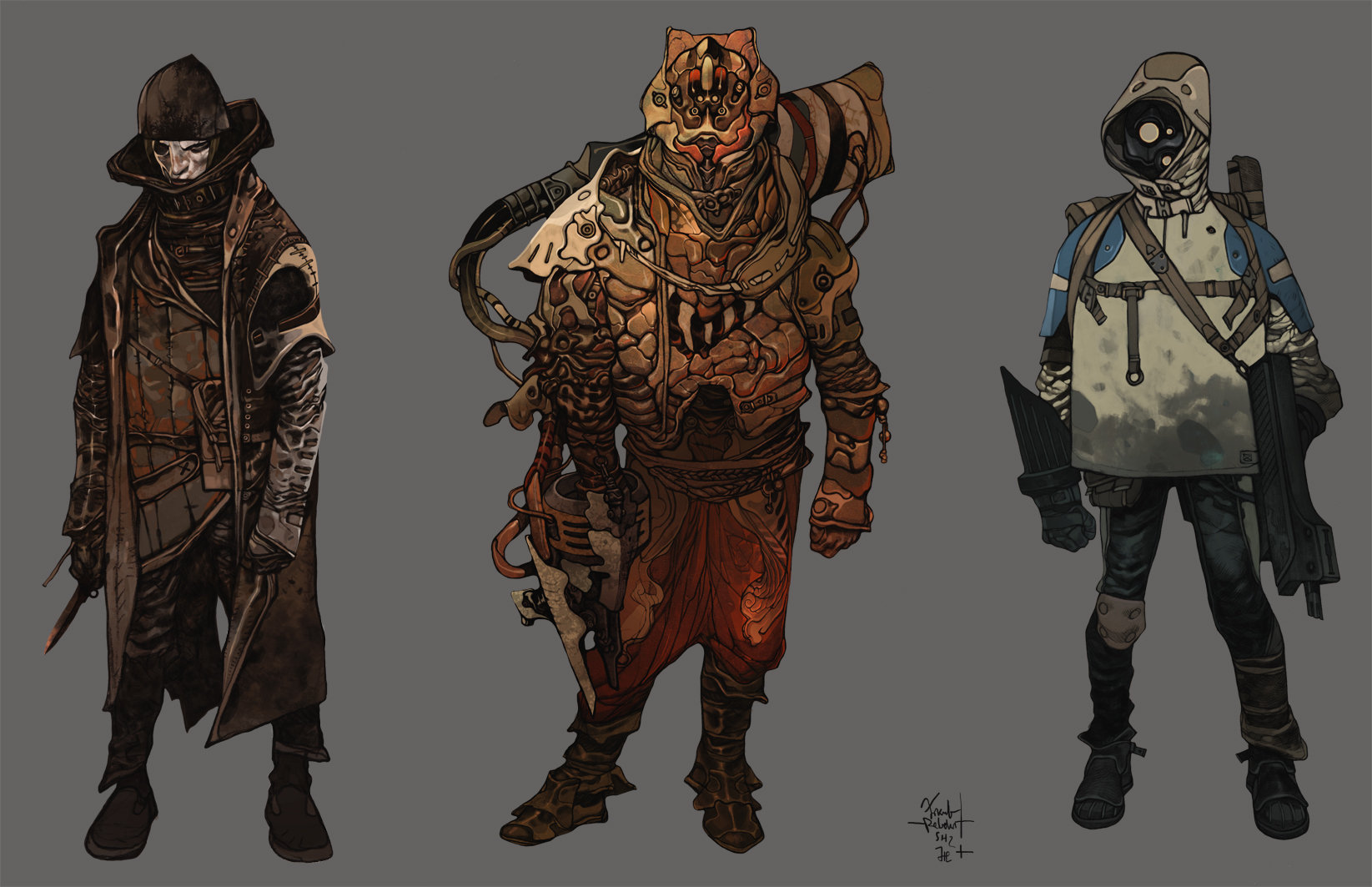
Like this. This is cool shit.
Credit, Jakub Rebelka

Skills

One of the main breaks with the core rules lies in the skills available to characters. The current list of skills (including those from Eldritch Cock) stands at:
  • Architecture
  • Bushcraft
  • Climb
  • Languages
  • Leadership
  • Luck
  • Medicine
  • Seamanship
  • Search
  • Sleight of Hand
  • Sneak Attack
  • Stealth
  • Tinker
While these serve reasonably well for a game of Early Modern dungeon crawling, they do miss out on several sci-fi aspects like computers/programs and advanced technology. I've also never liked the Search skill in LotFP - I want my players to tell me what they are doing and how they are searching for something, not just roll and hope for the best.

With this in mind, I have changed the skill list for Adrift on the Night's Black Sea to be as follows:
  • Data - used for manipulating computer programs and other software.
  • Climb - as stock, but it also affects strenuous actions (i.e. skill rolls or combat) in low/zero-g environments.
  • Etiquette - this isn't a persuade skill, but reflects a character's knowledge of how to phrase conversations and hold themselves in delicate matters among different social strata.
  • Language & Culture  - I'm running off the concept that language = culture, and learning one almost always gives insight into the other.
  • Leadership - as stock in Eldritch Cock, used to 'encourage' hirelings.
  • Luck - as stock in Eldritch Cock, provides a pool of re-rolls.
  • Medicine - as stock in Eldritch Cock, improves HP recovery.
  • Pilot - used when attempting risky manoeuvres in a vehicle or on a mount.
  • Science - used when analysing an unknown substance, organism or phenomena.
  • Stealth - as stock. Still not a superpower.
  • Tech - used for manipulating mechanisms and machines.
The list isn't perfect, but it accomplishes what I want it to: it provides the PCs with meaningful ways to interact with the setting, whether that's repairing an overheated railgun on a voidship with the tech skill or analysing the properties of a xeno narcotic with the science skill.

Credit, Lorenz Hideyoshi Ruwwe

Backgrounds

I'm always debating the best way to handle PC knowledge in an RPG. I can't stand the stock D&D/Pathfinder approach of knowledge skills, where facts are assigned an arbitrary difficulty and the player needs to either stack skill points to reliably learn information about the world. At the same time I feel like it's important the PCs should not know certain facts. I don't mean hidden or ancient knowledge, just relatively everyday things like who the High Priest is or why you shouldn't piss off the guys with red armbands, the sort of thing that a local or someone who has come from a certain part of society would know a decent amount about but an outsider wouldn't.

With the above in mind I've settled on using a similar system to Robert J. Schwalb's Shadow of the Demon Lord, in which PCs roll professions that relate to their general areas of knowledge. On topics familiar to their professions the GM is advised to have them either pass automatically, or roll a 10+ on a d20 with added boons (d6s that add positive modifiers).

Characters in Adrift on the Night's Dark Sea will roll a background during character creation, which will be a rough guide as to the nature of their general knowledge. A technician and priest will have quite different knowledge sets. If a player asks something that a character with their background would be likely to know, I'll just tell them. If it's something more esoteric but still within the background's wheelhouse then a d6 roll with advantage, aiming for 5-6, should suffice. Something at the reaches of that background's experience will need a 6 with no advantage.

The current background lists for PCs are as follows. Armatures do not roll backgrounds, but I'm going to encourage my players to come up with a guess at an armature's purpose based on what they roll for additional features:

Warrior (1d8):

  1. Soldier: You served in a polity’s armed forces, or were part of a mercenary band.
  2. Criminal: You broke heads for scrip.
  3. Raider: You plundered and looted for survival or pleasure.
  4. Medic: You stitched and bandaged flesh on the battlefield..
  5. Outsider: You lived on the edges of society, preferring life in the wilds.
  6. Religious: You served as a strongarm for one of the Solemnis’ fevered cults.
  7. Bodyguard: You risked life and limb to protect your employer.
  8. Engineer: You maintained weapons and war machines for your comrades.


Expert (1d8):

  1. Historian: You worked to recreate the knowledge of the Old World.
  2. Scholar: You sifted through the records of the past.
  3. Technician: You tinkered and repaired machines and equipment.
  4. Medic: You stitched and bandaged flesh.
  5. Emissary: You were sent to parley between polities and factions.
  6. Hacker: You lost yourself in the streams of data coursing through the Solemnis.
  7. Botanist: You tended to an agri-dome plantation or investigated new crop strains.
  8. Pilot: You sat at the helm of voidcraft or atmospheric fliers.

Psion (1d8):

  1. Outsider: You advised, watched, and/or terrorised from the edges of society.
  2. Religious: You served, or led, one of the Solemnis’ fevered cults.
  3. Soldier: You served in a polity’s armed forces, or were part of a mercenary band.
  4. Scholar: You sifted through the records of the past.
  5. Spy: Your powers allowed you to go where others could not.
  6. Criminal: You used your powers for personal gain.
  7. Oracle: You gazed into the currents of the warp-aether to deliver guidance and prophecy.
  8. Emissary: You were sent to parley between polities and factions.

Credit, Ben Nicholas

Combat & Equipment

Eldritch Cock makes a few changes to stock LotFP combat rules. Characters have 4 bonus - Melee, Ranged, Firearms and Guard. I've merged Ranged and Firearms into the same category. My logic is that a separate firearms category is unnecessary as sci-fi armour will provide decent enough protection, as opposed to gunpowder weapons ignoring 5 points of AC in stock LotFP (which my internal logic sees as being due to Early Modern armour still catching up to new armour-piercing weaponry, despite the advantages of gunpowder weapons in training and ease of use). Also this means that someone with a nanofibre bow and monoblade-tipped arrows can compete on a similar footing to a gunslinger and still feel pretty cool about themselves.

In terms of weapon sizes I've gotten rid of the 'minor' category. All minor weapons are now small weapons.

PCs dual-wielding melee weapons (up to medium-size) may choose between a +1 Attack bonus or +1 AC bonus at the start of the round. PCs dual-wielding pistols may make 2 attacks, but each attack is made with disadvantage. A PC dual-wielding a melee weapon and pistol may make 2 attacks in melee, one normal melee attack at no penalty and one ranged attack at disadvantage.

Eldritch Cock rules also mean that all weapons to 1d8 damage, with small and minor weapons taking a penalty to against armour and great weapons getting a bonus. I'm keeping the 1d8 damage but removing the static penalties and bonuses in favour of weapon tags. Each weapon will have one or more tags that give it a specific attribute or feature. Weapons can be customised through attachments to add new abilities.

I'll be following up on equipment in a subsequent post.

Thursday, 23 August 2018

Adrift on the Night's Black Sea: Armatures

Somehow, I've gotten myself roped into running another game. It seems one of my Star Wars pitches was too appealing to pass up:

"The Solemnis took flight to the stars 200 years ago. Designed to transport a self-sustaining population to a new world, she held the combined knowledge and the most advanced technology of her homeworld.

Many of Solemnis' systems have failed irreparably over time, including navigation. No communications have been received from the homeworld in over a century, and the original crew are long dead. Their descendants debate on the fate of the vessel, and conflict is about to flare."

The group have requested that I run this using Lamentations of the Flame Princess, as that's what they're familiar with. I've also chosen to incorporate Raggi's playtest ideas in Eldritch Cock, as they're awesome.

So, the game is going to take place on a huge warp-capable generation ship that has lost contact with its homeworld and has suffered steady degradation over centuries, both mechanical and in a societal sense. No one really understands how the ship works any more, navigation and other functions have failed irreparably, and the original crew (now several generations down the line) has divided into factions vying for control of the vessel. I'm thinking Lost in Space-meets-40k-meets-Foundation, lots of tech-mysticism, societal collapse and weird space-horror shit, with a smattering of retro-futurism thrown in for good measure.

I'll be using Dan's ideas on O'Neill cylinders to design the Solemnis - I have an idea for a cluster of O'Neill cylinders rotating around the central command structure and engines. Travel between the different areas will be dangerous and different compartments will have wildly different biomes, technology levels and cultures. Underneath it all is old archaeotech from the Old World that no one understands but everyone wants.

The new LotFP playtest rules don't contain any material on demihumans, and I'm fine with that. I generally like running human-PC-only games as it helps me enhance the other-ness of demihumans. Also a vaguely sci-fi settings means I can have some weird aliens, mutants, and trans/post-human NPCs for them to encounter. However, to add a bit of variety I thought I'd add a robot-type class for my PCs to use. Enter, armatures.

Credit, Amir Zand

As I mentioned above, the current inhabitants don't really understand how the advanced systems of the Solemnis work and rely on rote dogma for maintenance tasks. This includes the fabrication system, which sometimes ejects artificial beings into the habitats. These beings don't really understand what they're doing either, but have a vague idea of some purpose they were designed for. These beings are known as armatures and are generally humanoid in form, but often sport bizarre  and sometimes contradictory characteristics.

Class: Armature

You were created for a purpose. What that is, you’re not exactly sure. No two of you are exactly alike, although the mindless shells that perform rote tasks around the Solemnis clearly share a similar mindset. You’re different, though. Your sinews of plasteel and nerves of nanofilament mark you out from the organic passengers of the Solemnis, and your individual thoughts and desires distinguish you from your artificial brethren. What lies ahead?

Class Features:
  • Roll your stats normally, then roll randomly for locomotion, function, and design quirk. Adjust stats and abilities accordingly.
  • You self-repair at the same rate of healing as an organic, but the Tech skill applies to treatment in place of Medicine. Medicines and stims won’t work on you, but neither will poisons or most toxins.
  • You don’t need to eat or breathe. You only ‘sleep’ for 4 hours.

Credit, Jakub Rebelka

Locomotion (1d8):
  1. Insectile Legs: You scuttle around on a number of multi-jointed legs with gripping feet. You make all Climb rolls with advantage when not in Zero-G.
  2. Quadruped: Your torso emerges from a four-legged chassis. You count as being mounted at all times, ignoring the ranged penalty. You can climb normally, but slowly.
  3. Tracks: You clatter about on a set of treads. You move at full speed when navigating difficult terrain, but large obstacles can block your passage. You make Climb rolls with disadvantage.
  4. Wings: A pair of vibrating gossamer wings sprout from your shoulders. You can fly at your normal speed, but it takes an action to take off. 
  5. Bipedal: No special effects.
  6. Bipedal: No special effects.
  7. Bipedal: No special effects.
  8. Bipedal: No special effects.

Function (1d12):
  1. Peacekeeper: In-built armour plating grants you +2 base AC.
  2. Cargo Loader: Gain +2 STR.
  3. Medical: Gain +1 to your Medicine skill.
  4. Astrogation: Gain +2 INT.
  5. Hydroponics: Gain +1 to your Survival skill.
  6. EVA: Take advantage on all Climb rolls when in Zero-G.
  7. Psi-Monitor: Gain +2 CHA. You are aware of Psionic Powers used within 100’.
  8. Maintenance: Gain +1 to your Tech skill.
  9. ICE-Host: Gain +1 to your Data skill.
  10. Protocol: Gain +1 to your Etiquette skill.
  11. Analysis: Gain +1 to your Science skill.
  12. Navigation: Gain +1 to your Pilot skill.

Design Quirk (1d20):
  1. Multispectrum Vision: You can see in the dark and have a 1-in-6 chance to detect invisible objects/creatures.
  2. Inertial Compensators: You can fall 20’ instead of 10’ before suffering damage.
  3. Charge Capacitors: Enemies who attack you in melee must Save or suffer 1 damage.
  4. 360° Vision: You can see all around you and are only surprised on a 1-in-6.
  5. Afterburner: You can dash a distance equal to double your movement rate but can’t move for 1d6 Rounds afterwards. Charges made with this deal triple damage.
  6. Targeting Laser: You can mark an exposed target as an action. Your ranged attacks against this target are made with advantage, and you will always hit them when firing into melee (unless you fail your hit roll). This ends if you make any other action or if the target moves to cover.
  7. Revenant Protocols: When reduced to 0HP or less you may act normally for an extra Round before losing consciousness.
  8. Babel Library: You make all Language & Culture skill rolls with advantage.
  9. Animus Cells: You heal at twice the normal rate.
  10. Mechadendrites: You have mechanical tentacles instead of arms. They can fit into tight spaces and you take advantage on all grappling rolls.
  11. Sub-assembly: You can detach one of your arms and give it a set of instructions, i.e. pull this lever, hold this object until X happens etc. It will interpret your instructions quite literally.
  12. HAZMAT: You can store toxins and poisons in internal reservoirs and project them at a target. You can store one projection’s-worth at a time.
  13. Heat Shield: You make all saves to resist heat and flame effects with advantage.
  14. Luminous: You can project a beam of light as bright as a torch for a number of hours equal to your Level.
  15. Quantum Manipulation: Gain +1 Luck.
  16. Extra Arm: You have an additional arm. Nice one.
  17. Smokescreen: Once per day per level as a regular action you can project a cloud of thick smoke that covers a 50’ area, obscuring all within from sight.
  18. Alacrity Fibres: Once per day per level, as a free action, you may declare that you act first in initiative order. If you attack, make the attack roll with advantage. You must Save after your turn or suffer 1d8 damage.
  19. Chameleoline Skin: If you stand perfectly still you can blend in with your surroundings. Some things may still be able to sense your presence.
  20. Holdout Compartment: There is a small compartment concealed somewhere on your body. It can hold an object the size of a handgun and will defeat all but the most thorough investigations.

Blog Migration: BearBlog

 PSA: I'm in the process of migrating this blog over to BearBlog. Find me at: https://ironandink.bearblog.dev/ . No further updates will...

Popular Posts