Monday, 10 June 2019

Yoon-Suin: Lamentations of the Purple Princess


Because I apparently cannot keep myself confined to a single idea, I'm going to be running a casual game for some friends in the tea-soaked, opium-hazed lands of Yoon-Suin. I've owned Yoon-Suin for a while now, and it's one of the few settings that always manages to crawl into the back of my mind when I think about running a game. Something about the ephemeral, nihilistic, amoral decadence of its haunted jungles and flesh-crammed cities sticks in my soul, and now I've got some players who are fully on board with plumbing the depths of this ancient, depraved land.

I've decided to use Lamentations of the Flame Princess to run the game, as it shouldn't require too much conversion from the source book and it's probably the system I'm most familiar with. However that's not to say that the rules will be unedited; the game is going to be run in a casual fashion - the group will only be able to play once every 1-2 months but they should be all-day affairs. As such I want to make sure that characters can be created (and killed off) quickly and easily, that the gameplay supports a mechanism for ending a dungeon delve halfway through due to time constraints, and that the players have downtime options for their characters to keep things ticking over in the time between sessions.

This post is going to act as a hybrid guide/archive of links to other things I'll be writing up for the game. It will be edited and updated as I add to it. Sources will, of course, be credited.


Florian Neven

Character Creation & Basics

  1. Roll stats: 3d6 in order. Swap two if desired.
  2. Pick a class (warrior, thief, magician, holy man, slug man, crab man, dwarf) and determine starting spells/prayers (if applicable). This also determines your alignment.
  3. Roll your background (which gives you some starting gear, some skills and your social position) and determine social standing.
  4. Roll your complication (what got you into the adventuring life, something like addictions, debts, enemies etc.).
  5. Roll starting cash and determine starting gear.
  6. Choose a name and appearance!

Ability Scores
Charisma (CHA)
Gravitas, leadership and magnetism. Used to inspire loyalty in underlings and comrades. 

Constitution (CON)
Hardiness and overall health. Affects your HP total, positively or negatively. 

Dexterity (DEX)
Co-ordination and speed. Affects your AC total, ranged attack modifier.
  
Intelligence (INT)
In-world knowledge and mental fortitude. Affects your Languages skill and saves vs Magic.

Strength (STR)
Brawn and muscle. Affects your melee attack modifier and your d6 target to break open doors etc. 

Wisdom (WIS)
Divine favour and luck. Affects all other saves. 


Class
Next, choose your class and rolls your starting HP. Below are some brief details on each one, but I'll be writing a more in-depth post soon. Each class is designed to have a specific focus:

  • Warrior: you're good at killing things, you can choose weapon specialisations to improve your kill-iness.
  • Thief: you know a lot, you're the only class that gets reliable skill bonuses, allowing you to interact with lots of different things.
  • Magician: you have breached the veils of the arcane and can cast arcane spells, you can also create magic items with enough resources.
  • Holy Man: the gods favour you strongly, you can cast divine prayers and can also create divine items with enough resources.
  • Dwarf: your masked people are a remnant of their former glory, but you are skilled in battle and you know the underworld well.
  • Slug-Man: you sit at the top of the Yellow City's decadent hierarchy, and you know a spell or two.
  • Crab-Man: you are a slave, but you are mighty and your shell is as strong as steel.

Saves
Saves relabelled as follows (with thanks to James Young):
  • Paralyse to Stun - movement-based effects.
  • Poison to Doom - effects that bypass HP damage, like poison.
  • Breath to Blast - Area of Effect attacks.
  • Magic - remains as-is, used for saving against... Well, magic. Includes magic items, divine and supernatural powers.
  • Magical Device to Luck - when none of the above apply.


Skills


LotFP stock skills reorganised into the following:
  1. Animal Handling (used to train, command, and ride animals)
  2. Arcana (used to identify magical items and spells)
  3. Appraise (used to assess an item's value before selling it)
  4. Backstab (used when attacking flanked or surprised enemies)
  5. Bushcraft (used to find food and shelter in the wild, and for hunting/tracking)
  6. Climbing (used when climbing things in difficult circumstances)
  7. Languages (used when first encountering a new language to see if it is known)
  8. Medicine (used in first aid, long-term care and identifying diseases)
  9. Sailing (used when piloting watercraft in difficult circumstances)
  10. Sleight of Hand (used when picking pockets, fast reloading etc.)
  11. Stealth (used to stay hidden and silent)
  12. Tinkering (used when interacting with machinery and mechanisms)
Thieves are skill-specialists and receive skill points when levelling up, but each character gets a few skill points from their background.


Combat


Time
Each Round represents about 1 minute of time passing. Each Turn is 10 Rounds, or 10 minutes. 


Initiative
Decided on party basis - each side rolls 1d6 and the winner goes first. Re-rolled in subsequent Rounds. 


Actions
You can move (up to your distance rating) and make an action (an attack, using an item, casting a spell etc.) in a single Round. Alternatively, you can move twice.

You can also take a few minor actions (dropping something, falling prone etc.) on your turn, within reason, and as many free actions as you like (shouting something, looking round etc.).


Dual Wielding
On a hit, roll damage for both weapons and use the higher result.


Parry
You can Parry as a reaction to being attacked, which increases your AC by +4 but takes up your next Round.


Ammunition
50% of spent ammunition can be recovered intact after a battle. 


Magic
Casters must declare they are casting a spell before initiative is rolled. If they suffer damage before unleashing the spell then they must save vs Magic or the spell escapes them and is wasted. They can still act normally if this occurs. A critical failure on the save will result in a Thaumaturgic Revelation or an Arcane Cascade, depending on the type of spell cast. 


Critical Success/Failures
Natural 20s are critical successes, natural 1s are critical failures. Critical successes in combat do maximum damage (with a potentially gory finish) and critical failures damage your equipment. If an enemy gets a critical success against you, it damages your equipment; if an enemy rolls a critical failure in melee you can make an immediate counter-attack.


Health & Damage


HP
Hit Points are a buffer that prevents real damage. Once you reach 0HP you start accruing Wounds. 


Wounds
Wounds are serious injuries that have lasting effects and a set time to heal. Once you reach a certain point on the Wounds track, you die. Some deaths are lingering and can be avoided with treatment and luck, but some are instant. 


Shock
Some Wounds cause your character to suffer ongoing damage. For each point of Shock you have, your character moves an equivalent number of spaces up the Shock track at the end of the Round and immediately suffers the effects. A successful Medicine check from another character removes Shock and moves you back down the Shock track equal to the margin of success, to a minimum of 1. 


Healing HP
You can heal 1d8+CON HP by having an hour's break for lunch, provided you have a fire, food and water (courtesy of Arnold K.'s GLOG). A night's rest with a meal, campfire and shelter (a bedroll at minimum, a tent if the weather is bad) restores all HP, otherwise it counts the same as lunch. 


Healing Wounds
You need bed rest/light duties to recover from Wounds. Each wound has a duration in days (affected by your CON) that it takes to heal. Once per week, while getting bed rest in comfortable surroundings, you can be treated by another character with the Medicine skill. Success means your recovery is sped up by 1d6 days. Failure means that some element of your Wound becomes permanent due to the physician's incompetence. 


Poison
Some creatures can poison you. Like Shock this builds up over time but is tracked every Turn instead of every Round. The Medicine skill can't help you here, but save vs Doom each Turn - on a success you lose a point of Poison and decrease 1d6+CON spaces on the Poison track.


Disease
Diseases also use a track system. Disease is tracked in days instead of Round and Turns. Make a save vs Doom (affected by your CON) once per day - a successful Medicine check provides a 1d4 bonus - on a success you lose a point of Disease and gain a 1d4 bonus on your next save. As diseases often take longer to develop their tracks are often unique, so each plague brings different hazards.


Ability Damage & XP Drain
Some monsters (and other things) can directly damage your stats, you die if any are reduced to 0. Damaged Ability Scores regenerate at a rate of 1 per day if you are active, or 1d6 per day if you rest.

Really dangerous supernatural creatures can drain your XP (they suck the life and vitality right out of you) and cause you to lose levels if enough is drained. If you lose a level due to XP Drain your character immediately ages 2d10 years, and can take penalties due to advanced age. XP Drain cannot be reversed, save by powerful magic or artefacts, but you continue to gain XP as normal from your new total.


Magical Healing
Both arcane and divine magic can provide healing. HP is restored first, then start knocking off recovery days. Save vs Luck when your Wounds are healed - if you pass then you can be healed again the next day, otherwise you require a week's rest as the magical energies sap your strength. Certain spells can also cure Poison or Disease.


Magic


Starting Spells
Magicians start play knowing 3 random spells, rolled randomly from the Level-less Spell List. Holy-(wo)men start play knowing 3 random prayers rolled up using Maze Rats' spell generator from aspects of their deity. These are recorded in a spellbook or book of prayer.


Prepared Spells
After a night's rest, a magician or holy-man can prepare a number of spells per day equal to their level. When casting a spell you have prepared, save vs Magic - on a success the spell can be reused, on a failure the spell escapes you and you must prepare it again the next day. This represents the ability of the caster's mind to channel arcane or divine power - as they become more powerful so does their ability to control their abilities.


New Spells
Both magicians and holy-men gain a free random spell/prayer upon levelling up.


Spell Power
Some spells and prayers scale with your level, allowing you to adjust the impact when casting the spell. 


Creating Magic Items
Magicians and holy-men can make magic inscriptions, brew potions and create magic vessels. Any of these activities takes one week of uninterrupted downtime in an appropriate environment (laboratory, library etc.) as well as costing 1d6gp in commonly available reagents.

You must use materials that are soaked in magical, spiritual or otherwise otherworldly energy when creating something magical. For example - regular parchment can't hold the magic needed to make a magic scroll but the ritually tattooed and tanned skin of a prince, or a spell etched into the scale of a dragon definitely could. Likewise a regular length of wood is entirely unsuited for use as a magic vessel, but the finger of a treant, or the petals of a lily that grows in a magic spring would be perfect for a vessel or potion base, respectively.

Inscriptions are one-use instances of a spell - when they are cast the inscription crumbles to ash and adds an extra level of the appropriate class to the spell effects. Thus, scrolls can be cast by anyone (even non-spellcasters) if they have been identified and are legible.

Potions distil the essence of a spell into liquid form. It takes an action to drink a potion and the effects take place immediately. Like inscriptions, potions provide one appropriate level to the effects. The nature of the spell will usually make the effect of the potion obvious, but if not then consult me.

Vessels are a physical containers for spells, i.e. a magic wands or staves. A vessel has an integrity rating based on how long the base material was exposed to magic - 1d100 years exposed for an organic material, decades for an inorganic one. Imbuing a spell into a vessel decreases its integrity by 2d10 years/decades. When creating the vessel you must confirm how many of your levels you are investing into it. Your powers are then stripped from you for an equivalent number of weeks. The vessel has this many levels that can be used to cast the spell contained within, and you can add your own levels on top of this. When you attempt to use the vessel you must roll under its integrity on a d100, adding 10 to your roll for each of your own levels that you added. A successful Arcana check reduces the result by 10 for each margin of success, to a minimum of 10 (1). Success means that the spell casts as normal, failure means the vessel loses d100 integrity and you suffer a Arcane Cascade or Thaumaturgic Revelation. If a vessel is reduced to 0 integrity it is destroyed in an explosion of barely constrained chaos.


Equipment & Encumbrance


Armour
LotFP standard armour - ascending, starts at 12. Usual light/medium/heavy armour. Medium armour makes swimming hard (Save vs Stun to keep afloat), heavy armour sinks. It takes one Round to don or remove Light/Medium armour, it takes one Turn to do the same with Heavy armour, and you need help to do it.

Shields give flat +2 AC (seriously, have you ever tried stabbing someone using a shield?). Shields can be sundered to reduce incoming damage by 1 die size.

Bucklers and off hand melee weapons give +1 melee AC. 


Firearms
One type available - the fire lance. Mostly based on LotFP's matchlock rules:
  • Requires two people to use - one to hold and one to fire.
  • 10 round reload time (Sleight of Hand can be used to halve reload time, as per James Young's house rules).
  • Ammunition charge takes up a single inventory slot.
  • Fires in a 10ft cone - targets must save vs Blast within close range. Roll to hit with disadvantage on single target outside of close range. Does 2d8 damage.
  • 2/10 chance of misfiring, 4/10 chance in humid/damp conditions, 6/10 chance in wet conditions.
  • Causes an immediate morale check on any combatants not used to gunpowder weapons.


Encumbrance
Standard LotFP fare. The top 3 items in your inventory are on your belt or in pockets and can be accessed as a minor action, otherwise you need to spend a Round rummaging in your backpack.

100 coins counts as a single item. Rations, torches and most small items can be bundled 5 to a slot. 20 units of ammunition can be carried in a quiver or bullet pouch as a single item, extras can be carried in bundles of 10 in your main bags. If in doubt, ask me.


Item Damage
If an enemy hits you with a critical hit they will damage your armour. Likewise a critical miss with your weapon will damage it. Each point of armour damage reduces its AC bonus by 1 - when it reaches 0 the armour is destroyed. Each point of weapon damage reduces its damage die by one step - if it is damaged on a 1d4 die then it breaks completely (thanks to James Young for this one).

Armoursmiths and weaponsmiths can repair damaged equipment for a fee. Certain spells may be able to do the same.


Adventuring & Downtime


Wrapping Up
If you get halfway through a dungeon and the session ends, we'll wrap up using a set of rules that I'm writing up. I'll ask you some questions, you'll make some rolls and we'll see what shape you end up in back in town.


Downtime
Your characters will have to do things in-between sessions. I'll be detailing these in a further post and will update them here. Once you're back in town and your lucre has been divided up you'll need to do the following:
  1. Set your living standard for the next month. This will affect your healing, social standing and the type of events you'll experience during downtime.
  2. Hold funerals for fallen party members, if you were able to bring the bodies back with you.
  3. Go shopping.
  4. Choose your downtime activity. These could give bonus XP, a chance to earn more money, magic item construction time, etc.. A character can choose one downtime activity.
  5. Roll for rumours and choose what you want to do next session.
  6. Lay out groundwork for your next expedition - stock up on supplies, recruit hirelings and henchmen, arrange travel services etc.

Sunday, 2 June 2019

The Hierarchy of Forests, or Forest Feudalism

Royal forests are cool. From Wikipedia:

"...under the Norman kings (after 1066), by royal prerogative forest law was widely applied. The law was designed to protect the venison and the vert, the "noble" animals of the chase – notably red and fallow deer, the roe deer, and the wild boar – and the greenery that sustained them. Forests were designed as hunting areas reserved for the monarch or (by invitation) the aristocracy (see medieval hunting). The concept was introduced by the Normans to England in the 11th century, and at the height of this practice in the late 12th and early 13th centuries, fully one-third of the land area of southern England was designated as royal forest; at one stage in the 12th century, all of Essex was afforested, and on his accession Henry II declared all of Huntingdonshire forest."

Royal forests, by nature of their creation and mode of use, are special places. Perhaps more so than anywhere else in the land, they are places where the king and his nobles leave their mark. Anyone can take and hold a castle, it's just a pile of stones, but if anyone can hunt in a royal forest then it ceases to be a royal forest. That's why poaching in a royal forest is punished so harshly - it's both a physical and spiritual theft against majesty itself. Naturally, royalty infuses these places and enforces its own indelible order on its inhabitants in a mirror of mankind's feudal society:
  • Kings & Queens (Stags & Does)
  • Dukes and Counts (Bucks)
  • Barons (Boar)
  • Knights (any animal that seems particularly noble and doesn't fit into the other categories)
  • Peasants (other prey species)
  • Outlaws (Wolves, Bears)
 Maybe the examples below are literal. Maybe they're metaphorical. Maybe they're both.


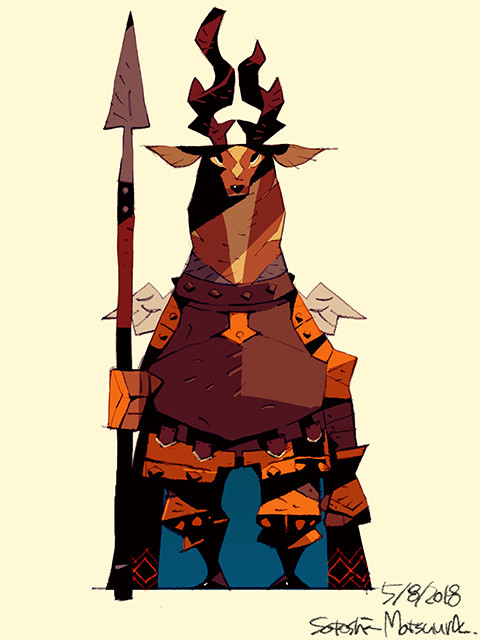
Stag King

Satoshi Matsuura

A braying call heralds the charge of the King of the Forest, and the forest bows to his will. A shining aura surrounds him as he thunders towards you, glittering antlers rearing skyward. None feel the influence of the glory of royalty more than deer, the favoured hunt of monarchs.

AC: Plate, HD: 8, Attack: 2d8 lance + Save or be thrown 30ft into the air, Move: 50', Morale: 10, Special: Aura of Royalty - when first encountered any foreign (to the forest) creature must Save or abase themselves before the King of the Forest.

Interesting things: Gilded antlers, royal lance, oak-pattern royal seal, briar-walk boots.


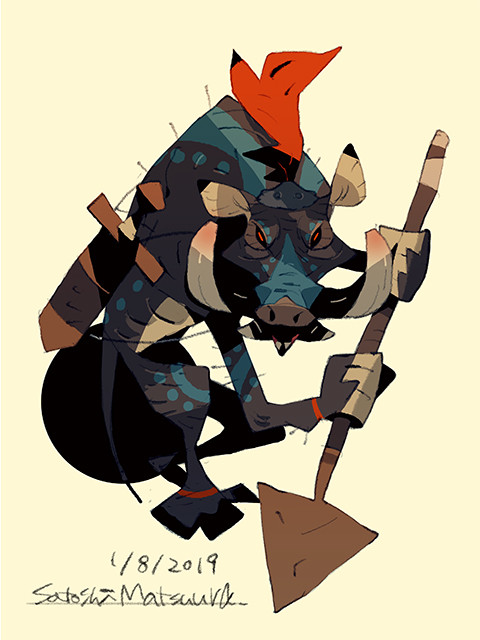
Boar Baron

Satoshi Matsuura


A muffled grunt echoes from across the clearing. Then again, and again, rising in tempo until reaching a screeching squeal. The heavy-bodied baron and his retainers close in for the kill, froth at their lips and bloodlust in their eyes. The King of the Forests trusts his barons to police his lands and guard his borders.

AC: Chain, HD: 6, Attack: 1d8 sword + Save or bleed, Move: 30', Morale: 10, Special: Blood-scent - the baron can sniff out the scent of any wounded outsider within 3 miles.

Interesting things: Fortifying fats, razor tusks, engraved nose-ring, armoured bristles.


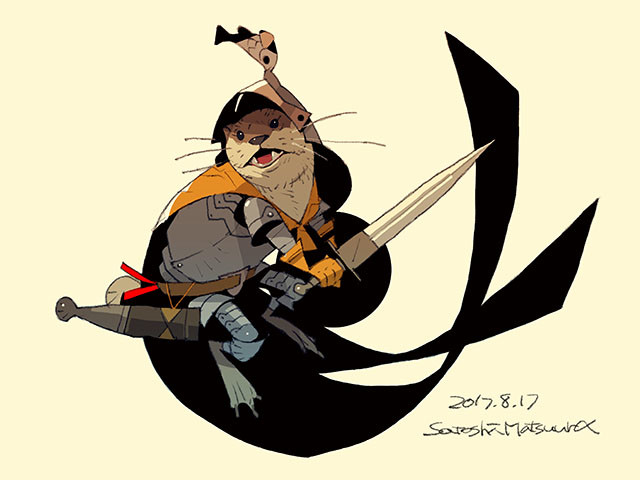
Otter Knight

Satoshi Matsuura

Lost and tired, your party stops by a river to make camp and rest. You think you're safe, but when you go to draw water from the river you see too late the glimmer of steel beneath the surface.

AC: Chain, HD: 4, Attack: 1d6 sword, Move: 30'/Swim 60', Morale: 8, Special: Water walk - when immersed, the otter knight can move to another body of water within 1 mile as a full action. This works in a river, stream or pond, but not in a bucket.

Interesting things: Gill helm, insulating coat, swimming boots.


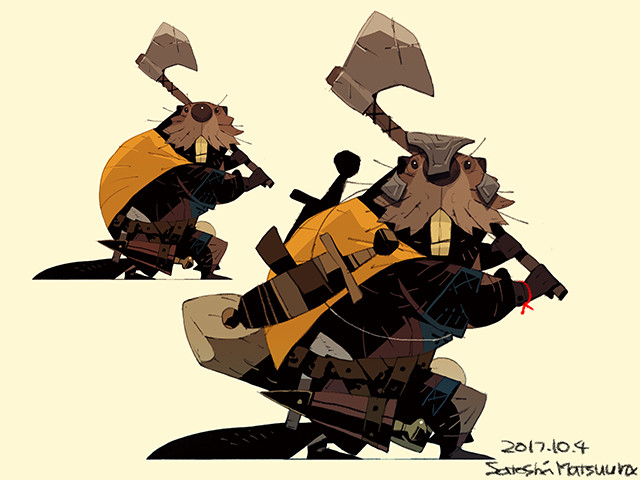
Beaver Man-at-Arms

Satoshi Matsuura

It is a lord's right to charge a toll to all those who cross his bridges while in his domain. The lords of the forest entrust the construction and wardship of these vital passages to trusted servants, and none are more trusted in this matter than the beavers. Their blunt demeanours and stout axes are more than required to ensure that travellers pay up.

AC: Chain, HD: 3,  Attack: 1d6 axe/1d8 crossbow, Move: 30'/Swim 60', Morale: 8, Special: Woodworker - instead of dealing damage, the beaver man-at-arms can instead choose to destroy an opponent's wooden shield with a swift bite of their teeth.

Interesting things: Bag of bridge fares, waterproof oiled pouch, plans for a nearby fortification.


Fox Verderer

Satoshi Matsuura

Although the King of the Forest does not hunt, he nonetheless holds swathes of the forest for himself. He entrusts his chosen servants to maintain these lands in his absence, and to catch and punish those who would wrong him. The crafty fox serves him well in these matters, stalking criminals silently and administering the king's justice swiftly.

AC: Leather, HD: 2, Attack: 1d8 longbow/1d6 cudgel, Move: 50', Morale: 8, Special: Shadowstep - instead of a move action, the fox verderer may teleport to a spot 30' away.

Interesting things: A nefarious trap, seeker arrow, map of hidden trails in this area.


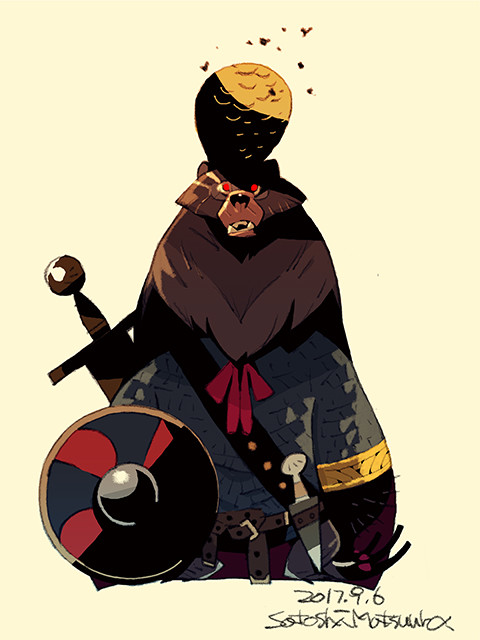
Bear Outlaw Boss

Satoshi Matsuura

The wolves and bears both reject the King of the Forest's claim to the throne, and their mutual enmity can sometimes be put aside in pursuit of mutual raids. A grown bear is a fearsome foe, and even more so when drunk on blood-mead, wielding weapons of awesome size and surrounded by clouds of bees that nest in their armour. Few can stand against them.

AC: Plate, HD: 6, Attack: 2d8 greatsword, Move: 30', Morale: 10, Special: Stinging cloud - the bear outlaw boss emits a cloud of angry bees when struck. All targets engaged in melee for the next turn attack with disadvantage.

Interesting things: Horn of blood-mead, royal jelly comb, armoured pelt, rune-inscribed bear claw necklace.

Fiefdoms

With thanks to Skerples' feudalism writings, Crusader Kings II and Game of Thrones, for getting my head back into the game. Behold the outline of a British mythology-inspired medieval setting. Bold places are on the map, you'll have to guess where.

Jose Daniel Cabrera Peña

The Bastard's Conquest is some 250 years past. The land is at a rare moment of peace, but a precarious peace it is.

To the north, the Seelie King of Alba rules beyond the ruins of the Rûmish wards of the Vallum Hadriani. Few Anglians have encountered the sidhe that whisper in his ear, fewer still have lived to tell the tale. Raiders sally from both sides of the border but sometimes, when the winter night is still and the moon is full, the mournful horn of the Wild Hunt heralds an altogether different threat.

To the west, the last Prince of Mount and Vale has been slain and Cambria has been subdued with an iron fist. However, the Prince's son was smuggled to Breizh, far to the south, and seeks supporters to avenge his father and claim his birthright. The populace glower under the rule of the Marcher lords and the high mountain valleys still hold hidden bastions of the Old Gods.

Hex Kit is great for mapping out your totally original ideas.

Past Cambria over the sea, the Crown has carved out a tenuous foothold in Hibernica. What started as an easy conquest became a brutal stalemate as armoured knights were ambushed by saffron-cloaked javelineers and brutal mailed axemen. Tales returned of great shaggy beasts battering down palisades and keeps. The war is not over, but each side licks their wounds as they wait for the conflict to flare again.

To the south across the Mare Francorum, the King of the Franks looks enviously upon the King's continental holdings, and conspires to claim them for himself. The jarls of the King of the Northmen have largely given up the practice of raiding from their Island Holdfasts, but hard men live hard lives and piracy and mercenary pay are now often as lucrative.

In Anglia itself, noble squabbles are a constant threat. The barons look to safeguard their privileges and expand their influence by any means necessary, and the great counts and dukes even more so. The Church is divided between its loyalty to the High Priest and its duty to the King. Rûmish artefacts and dungeons are scattered throughout the land, calling the foolhardy like moths to a flame. Magic is outlawed by divine decree across the Church's reach, but there are always those willing to grasp at otherworldy power at the risk of their sanity, lives, and immortal souls.

Saturday, 1 September 2018

Adrift on the Night's Black Sea: Equipment Tags

In my previous post I mentioned that all weapons will deal 1d8 damage in line with the Eldritch Cock playtest rules. Instead of variable damage weapons in Adrift on the Night's Black Sea will feature different tags that alter their abilities and effects. Tags can also be applied to armour and other bits of equipment. Both positive and negative tags will be featured, though negative tags will normally be applied to weapons that have been improvised, scavenged or experimentally produced. My goals for this system are as follows:
  1. Simple - a tag will sum up the effect it has in a sentence or two. This can potentially link to other systems - if I ever publish this I will ensure links and references are included.
  2. Evocative - a tag's name will evoke a good sense of its effects, i.e. Irradiating, Fragile, Rending etc.
  3. Flexible - a PC should be able to apply and remove different tags to their equipment given the right resources, customising their kit to suit their needs.
I also planned to talk about the injury system I'll be using, as well as an outline of the psionics system that I've been mulling over, but this post became far too long.

Credit, Don Davis @ NASA Ames Research Centre

Equipment & Tags

A tag may only be taken once per equipment item unless otherwise specified.

Weapons

Weapons will have a certain number of innate tags, their size for example, that cannot be changed. These tags are determined at the creation of the weapon and are usually integral to their construction or function. A weapon's size will also determine how many tags it can have applied to it. Below is a set of base weapons for each size category. Below that is a list of further tags that can be applied, their restrictions, and list of weapons that I have come up with.

IMPORTANT: These are all still a work in progress and will more than likely be changed!

Base Melee Weapons

WeaponSizeInnate TagsFurther Tag Slots
Small WeaponSmallSmall - can be used while grappling.
1
Medium Weapon*MediumMedium - can be wielded in both hands for +1 damage.
2
Large Weapon**LargeLarge - must be wielded in 2 hands.
3

*Spears count as medium weapons and have their stock advantages/disadvantages as per core LotFP.
**Polearms count as large weapons and have their stock advantages/disadvantages as per core LotFP.


Base Ranged Weapons


WeaponSizeInnate TagsFurther Tag Slots
PistolSmallPistol - can be used in melee combat.
1
Rifle*MediumRifle - can be used as a melee weapon with -2 to hit.
2
Heavy WeaponLargeHeavy - takes a full round action to fire.
3
Bow**MediumSilent - makes no sound when fired.
2
Grenade Template***SmallThrown - this weapon is designed to be thrown at a target.
2

*This category covers rifles, shotguns, carbines and other two-handed firearms that don't qualify as heavy weapons.
**Note that bows will have access to a relatively small number of tags, but arrows may have one tag applied to them to allow for a number of different types.
***Grenades can be modified for different purposes, for example armour piercing grenades using the blast + hypervelocity tags, or a tear gas grenade using the gas + toxin tags. Rocket/grenade launchers are simply used for delivery purposes and have no tags of their own.

Reloading
After attacking with a ranged weapon, the wielder must roll to see if it needs reloading. To test this, roll 1d10. On a 1 the weapon must be reloaded. Bows and grenades do not make reload checks.

Further Weapon Tags
  • Autoloading (non-bow ranged only) - sophisticated ammunition feeders mean reloading this weapon counts as a minor action instead of a regular action.
  • Balanced (melee only) - this weapon is perfectly balanced for dual-wielding, increasing AC and hit bonuses to +2 when dual-wielding, or +1 if a large weapon. If both weapons are balanced this increases to +3.
  • Beam (non-grenade ranged only) - this weapon fires an energised beam or charge and its attacks have +2 to hit but can be impaired by thick smoke or dust clouds. This weapon uses power cells instead of projectile ammo - make all reload rolls with advantage.
  • Blast (grenades only) - this weapon unleashes an indiscriminate explosion that attacks AC12 or the target's base AC, whichever is lower. The weapon is irrevocably destroyed once used.
  • Cryogenic (non-bow, non-hyperthermic) - shots from this weapon chill and numb their targets. The target must Save on a successful hit or be slowed for 1d6 Rounds.
  • Energised (melee only) - this weapon is surrounded in a crackling halo of energy, gaining +2 to hit and damage rolls.
  • Gas (non-bow, non-beam ranged only) - this weapon projects a gas instead of a solid or energy projectile. While it has a short range this gas spreads quickly and bypasses most forms of armour and cover, taking +4 to hit.
  • Hyperthermic (non-bow, non-cryogenic) - this weapon superheats its targets. The target must Save on a successful hit or begin burning (see Injuries section).
  • Hypervelocity (non-beam ranged only) - this weapon fires solid ammunition with terrifying power, gaining +2 to damage. Enemies behind cover take no AC bonus when targeted by this weapon.
  • Ionic (non-bow) - this weapon is electrically charged and only deals 1d4 damage to organic targets, but artificial targets take double damage. Any artificial or cybernetically-enhanced target must also Save when hit or be stunned for 1d6 Rounds.
  • Irradiating (non-bow) - this weapon emits harmful levels of ionising radiation. The target must Save on a successful hit or suffer +2Gy cumulative rad exposure (see Injuries section).
  • Jet (non-bow, non-beam ranged only) - this weapon projects a liquid instead of a solid or energy projectile. This weapon has a moderate range and takes +2 to hit.
  • Lightweight - this weapon is non-encumbering, or counts as a normal item if oversized.
  • Needler (non-beam, non-bow ranged only) - this weapon fires needle-like solid projectils at a high rate of fire with very little recoil. This weapon takes +4 on hit rolls but deals 1d4 damage instead of 1d8.
  • Rapid Fire (non-bow ranged only) - this weapon has a terrifying rate of fire and rolls to hit and damage with advantage, but reload rolls are made with disadvantage. This weapon can suppress targets instead of directly attacking, who must Save or take disadvantage on their next attack roll.
  • Rending (non-bow) - this weapon slices and tears flesh with ease. The target must Save on a successful hit or begin bleeding (see Injuries section).
  • Scattershot (non-blast ranged only) - this weapon fires multiple projectiles with a single shot, allowing the wielder to attack 2 adjacent targets with their normal combat bonus but dealing half damage to each (roll once and divide by 2, minimum 1 damage each).
  • Silent (non-blast only) - attacks with this weapon make very little to no sound.
  • Thrown - this weapon is designed to be thrown at a target.
  • Toxic - this weapon delivers a specific poison or disease to its target. The target must Save or suffer the effects (see Injuries section).

Credit, Ariel Perez

Armour

Armour, unlike weapons, will not have innate tags. I found it hard to think up things that weren't otherwise explained elsewhere in the LotFP rules (like encumbrance and so on) so I thought it best to leave them blank. However it will still be possible to modify armour to add and remove tags.

Base Armour


ArmourBase ACTag Slots
Light Armour
 14
2
Medium Armour
 16
3
Heavy Armour
 18
4
Shield
 +2
1

Armour Tags
  • Ablative - this armour is layered with materials that divert shock and energy by vaporising or fragmenting. The first time the wearer of this armour would suffer weapon damage*, instead negate the damage and remove this tag. This tag can be taken multiple times.
  • Active Countermeasures - this armour has close-in weapon capability and can intercept grenades and other thrown or slow-moving missiles. When the wearer of this armour is targeted by a thrown weapon or arrow, or if a grenade or rocket would impact within 10', they may Save as a free action to intercept it before it impacts.
  • Autosenses - this armour holds integrated sensors and scanners. The wearer of this armour can sense heat and electrical signatures within 100' (if not obscured), see up to 200' away in darkness, and sense the chemical composition of the surrounding atmosphere.
  • Chameleon - this armour has chameleon circuitry embedded within it, allowing the wearer to blend in to their surroundings. The wearer's Stealth skill counts as +4 while they keep perfectly still, and +2 while they are moving - every 2 points of damage suffered reduces the Stealth bonus by 1 until the armour is repaired.
  • Commlink - this armour has an in-built communicator and recording apparatus capable of broadcasting up to three times the range of a handheld communicator.
  • Exopowered - this armour contains layers of carbon-mesh muscle and steel sinew to enhance the strength of the wearer. The wearer of this armour counts their STR as 2 higher than normal.
  • Grav-stabilisers - internal gravitic fields and gyroscopic stabilisers allow the wearer of this armour to keep their balance in nearly all situations. The wearer makes all Climb rolls and combat manoeuvre rolls to stay upright with advantage, and suffers no penalty in zero-g.
  • Integrated Weaponry - this armour has an integrated melee or ranged weapon, up to medium or pistol size. The bearer cannot be disarmed of these weapons but they may not have additional tags beyond their base.
  • Kinetic Dampeners - gravitic dampeners and endurance fibres allow this armour to absorb shocks and gravitational forces. The wearer of this armour will take falling damage for every 20' fallen instead of 10' and makes Saves vs g-force with advantage.
  • Lightweight - this armour's encumbrance is reduced by 1, or counts as a normal item if oversized.
  • Psi-Scanner - built-in psionic sensors allow the wearer a greater sensitivity to psionics. The wearer of this armour is able to detect psionic energy and psions, as well as identifying the effects of detected psionic energy.
  • Psi-Warded - advanced materials, their method of construction long forgotten, line this armour and reduce the effect of psionic powers on the wearer. The wearer makes all Saves vs Psionics with advantage.
  • Rad-Shielded - this armour is specifically designed to resist harmful radiation levels. The wearer of this armour makes all Saves vs Radiation with advantage.
  • Radiators - this armour holds sophisticated cooling systems to vent excess heat. The wearer of this armour makes all Saves vs heat effects with advantage, but is still vulnerable to being set ablaze.
  • Smokescreen - as a move action this armour can emit billowing clouds of smoke to mask its wearer. The smoke reaches up to 50' away from the wearer and the armour's reservoirs must be reloaded before it can be used again.
  • Static Discharge - internal capacitors bleed off kinetic energy as a last-ditch defence mechanism. Any opponent who damages the wearer of this armour in melee must Save or suffer 1 damage from an electrical jolt.
  • Survival Filters - internal filtration and reprocessing symptoms allow the wearer to survive without food or water for double the normal duration. They'll smell awful afterwards though.
  • Thrusters - the wearer of this armour can jump up to three times their movement under normal gravity (which requires a Turn to cool the engines), or move at the normal movement rate with ease in zero-g.
  • Trauma Kit - internal life support systems allow this armour to keep its wearer alive in cases of grievous injury. If the wearer of this armour is injured to the point where they start dying this armour automatically stabilises them for 6 hours, after which they will die if they do not receive treatment.
  • Vacc-Sealed - this armour is sealed against the cold void, and is also impermeable to most airborne toxins and diseases. The internal air supply will last for 8 hours.

Credit, Ariel Perez

Examples

Here are a few things that I came up with using the above tags:

Ranged Weapons

Laser Pistol
Tags: pistol, beam.

Machine Pistol
Tags: pistol, rapid fire.

Silenced Pistol
Tags: pistol, silent.

Hypodermic Rifle
Tags: rifle, needler, toxic.

Combat Shotgun
Tags: rifle, autoloader, scattershot.

Survival Rifle
Tags: rifle, beam, lightweight.

Heavy Machine Gun
Tags: heavy, hypervelocity, rapid fire, scattershot.

Plasma Lance
Tags: heavy, beam, hyperthermic, rapid fire.

Cryo Cannon
Tags: heavy, cryogenic, jet, lightweight.


Melee Weapons

Charge Prod
Tags: small, ionic.

Assassin's Knife
Tags: small, toxic.

Parrying Dagger
Tags: small, balanced.

Duellist's Chainblade
Tags: medium, balanced, rending.

Hunter's Javelin
Tags: medium, balanced, thrown.

Phoenix Blade
Tags: medium, hyperthermic, lightweight.

Rad Axe
Tags: large, energised, irradiated, lightweight.

Ion Maul
Tags: large, energised, ionic, rending.

Void Lance
Tags: large, balanced, lightweight, silent.


Grenades

Frag Grenade
Tags: thrown, blast, scattershot.

Chokegas Bomb
Tags: thrown, gas, toxin.

Incendiary Grenade
Tags: thrown, blast, hyperthermic.

Rad Emitter
Tags: thrown, gas, irradiated.


Armour

Infiltration Gear (Light)
Tags: autosenses, chameleon. 

Loading Apparatus (Light)
Tags: exopowered, kinetic dampeners.

Stillsuit (Light)
Tags: commlink, survival filters.

Voidsuit (Medium)
Tags: grav-stabilisers, thrusters, vacc-sealed.

Gladiator Armour (Medium)
Tags: ablative, lightweight, static discharge.

Psi-Enforcer Gear (Medium)
Tags: commlink, psi-scanner psi-warded.

Juggernaut Armour (Heavy)
Tags: active countermeasures, autosenses, integrated weaponry, smokescreen.

Reactor Suit (Heavy)
Tags: commlink, rad-shielded, trauma kit, vacc-shielded.

Mining Gear (Heavy)
Tags: exopowered, lightweight, radiators, survival filters.

Friday, 24 August 2018

Adrift on the Night's Black Sea: Rules (Of A Sort)

A science-fantasy setting represents a fairly significant break from the implied 16th century Europe setting of stock Lamentations of the Flame Princess. This has led me to tweak and change a reasonable number of rules, which I'll detail below. Before I do, let me say that the playtest rules in Eldritch Cock are a fucking godsend that makes dealing with anything class-related much easier because I don't have to fuck around with separate hit dice, XP tracks and saving throws anymore. It's now much easier to focus on cool shit.

Like this. This is cool shit.
Credit, Jakub Rebelka

Skills

One of the main breaks with the core rules lies in the skills available to characters. The current list of skills (including those from Eldritch Cock) stands at:
  • Architecture
  • Bushcraft
  • Climb
  • Languages
  • Leadership
  • Luck
  • Medicine
  • Seamanship
  • Search
  • Sleight of Hand
  • Sneak Attack
  • Stealth
  • Tinker
While these serve reasonably well for a game of Early Modern dungeon crawling, they do miss out on several sci-fi aspects like computers/programs and advanced technology. I've also never liked the Search skill in LotFP - I want my players to tell me what they are doing and how they are searching for something, not just roll and hope for the best.

With this in mind, I have changed the skill list for Adrift on the Night's Black Sea to be as follows:
  • Data - used for manipulating computer programs and other software.
  • Climb - as stock, but it also affects strenuous actions (i.e. skill rolls or combat) in low/zero-g environments.
  • Etiquette - this isn't a persuade skill, but reflects a character's knowledge of how to phrase conversations and hold themselves in delicate matters among different social strata.
  • Language & Culture  - I'm running off the concept that language = culture, and learning one almost always gives insight into the other.
  • Leadership - as stock in Eldritch Cock, used to 'encourage' hirelings.
  • Luck - as stock in Eldritch Cock, provides a pool of re-rolls.
  • Medicine - as stock in Eldritch Cock, improves HP recovery.
  • Pilot - used when attempting risky manoeuvres in a vehicle or on a mount.
  • Science - used when analysing an unknown substance, organism or phenomena.
  • Stealth - as stock. Still not a superpower.
  • Tech - used for manipulating mechanisms and machines.
The list isn't perfect, but it accomplishes what I want it to: it provides the PCs with meaningful ways to interact with the setting, whether that's repairing an overheated railgun on a voidship with the tech skill or analysing the properties of a xeno narcotic with the science skill.

Credit, Lorenz Hideyoshi Ruwwe

Backgrounds

I'm always debating the best way to handle PC knowledge in an RPG. I can't stand the stock D&D/Pathfinder approach of knowledge skills, where facts are assigned an arbitrary difficulty and the player needs to either stack skill points to reliably learn information about the world. At the same time I feel like it's important the PCs should not know certain facts. I don't mean hidden or ancient knowledge, just relatively everyday things like who the High Priest is or why you shouldn't piss off the guys with red armbands, the sort of thing that a local or someone who has come from a certain part of society would know a decent amount about but an outsider wouldn't.

With the above in mind I've settled on using a similar system to Robert J. Schwalb's Shadow of the Demon Lord, in which PCs roll professions that relate to their general areas of knowledge. On topics familiar to their professions the GM is advised to have them either pass automatically, or roll a 10+ on a d20 with added boons (d6s that add positive modifiers).

Characters in Adrift on the Night's Dark Sea will roll a background during character creation, which will be a rough guide as to the nature of their general knowledge. A technician and priest will have quite different knowledge sets. If a player asks something that a character with their background would be likely to know, I'll just tell them. If it's something more esoteric but still within the background's wheelhouse then a d6 roll with advantage, aiming for 5-6, should suffice. Something at the reaches of that background's experience will need a 6 with no advantage.

The current background lists for PCs are as follows. Armatures do not roll backgrounds, but I'm going to encourage my players to come up with a guess at an armature's purpose based on what they roll for additional features:

Warrior (1d8):

  1. Soldier: You served in a polity’s armed forces, or were part of a mercenary band.
  2. Criminal: You broke heads for scrip.
  3. Raider: You plundered and looted for survival or pleasure.
  4. Medic: You stitched and bandaged flesh on the battlefield..
  5. Outsider: You lived on the edges of society, preferring life in the wilds.
  6. Religious: You served as a strongarm for one of the Solemnis’ fevered cults.
  7. Bodyguard: You risked life and limb to protect your employer.
  8. Engineer: You maintained weapons and war machines for your comrades.


Expert (1d8):

  1. Historian: You worked to recreate the knowledge of the Old World.
  2. Scholar: You sifted through the records of the past.
  3. Technician: You tinkered and repaired machines and equipment.
  4. Medic: You stitched and bandaged flesh.
  5. Emissary: You were sent to parley between polities and factions.
  6. Hacker: You lost yourself in the streams of data coursing through the Solemnis.
  7. Botanist: You tended to an agri-dome plantation or investigated new crop strains.
  8. Pilot: You sat at the helm of voidcraft or atmospheric fliers.

Psion (1d8):

  1. Outsider: You advised, watched, and/or terrorised from the edges of society.
  2. Religious: You served, or led, one of the Solemnis’ fevered cults.
  3. Soldier: You served in a polity’s armed forces, or were part of a mercenary band.
  4. Scholar: You sifted through the records of the past.
  5. Spy: Your powers allowed you to go where others could not.
  6. Criminal: You used your powers for personal gain.
  7. Oracle: You gazed into the currents of the warp-aether to deliver guidance and prophecy.
  8. Emissary: You were sent to parley between polities and factions.

Credit, Ben Nicholas

Combat & Equipment

Eldritch Cock makes a few changes to stock LotFP combat rules. Characters have 4 bonus - Melee, Ranged, Firearms and Guard. I've merged Ranged and Firearms into the same category. My logic is that a separate firearms category is unnecessary as sci-fi armour will provide decent enough protection, as opposed to gunpowder weapons ignoring 5 points of AC in stock LotFP (which my internal logic sees as being due to Early Modern armour still catching up to new armour-piercing weaponry, despite the advantages of gunpowder weapons in training and ease of use). Also this means that someone with a nanofibre bow and monoblade-tipped arrows can compete on a similar footing to a gunslinger and still feel pretty cool about themselves.

In terms of weapon sizes I've gotten rid of the 'minor' category. All minor weapons are now small weapons.

PCs dual-wielding melee weapons (up to medium-size) may choose between a +1 Attack bonus or +1 AC bonus at the start of the round. PCs dual-wielding pistols may make 2 attacks, but each attack is made with disadvantage. A PC dual-wielding a melee weapon and pistol may make 2 attacks in melee, one normal melee attack at no penalty and one ranged attack at disadvantage.

Eldritch Cock rules also mean that all weapons to 1d8 damage, with small and minor weapons taking a penalty to against armour and great weapons getting a bonus. I'm keeping the 1d8 damage but removing the static penalties and bonuses in favour of weapon tags. Each weapon will have one or more tags that give it a specific attribute or feature. Weapons can be customised through attachments to add new abilities.

I'll be following up on equipment in a subsequent post.

Thursday, 23 August 2018

Adrift on the Night's Black Sea: Armatures

Somehow, I've gotten myself roped into running another game. It seems one of my Star Wars pitches was too appealing to pass up:

"The Solemnis took flight to the stars 200 years ago. Designed to transport a self-sustaining population to a new world, she held the combined knowledge and the most advanced technology of her homeworld.

Many of Solemnis' systems have failed irreparably over time, including navigation. No communications have been received from the homeworld in over a century, and the original crew are long dead. Their descendants debate on the fate of the vessel, and conflict is about to flare."

The group have requested that I run this using Lamentations of the Flame Princess, as that's what they're familiar with. I've also chosen to incorporate Raggi's playtest ideas in Eldritch Cock, as they're awesome.

So, the game is going to take place on a huge warp-capable generation ship that has lost contact with its homeworld and has suffered steady degradation over centuries, both mechanical and in a societal sense. No one really understands how the ship works any more, navigation and other functions have failed irreparably, and the original crew (now several generations down the line) has divided into factions vying for control of the vessel. I'm thinking Lost in Space-meets-40k-meets-Foundation, lots of tech-mysticism, societal collapse and weird space-horror shit, with a smattering of retro-futurism thrown in for good measure.

I'll be using Dan's ideas on O'Neill cylinders to design the Solemnis - I have an idea for a cluster of O'Neill cylinders rotating around the central command structure and engines. Travel between the different areas will be dangerous and different compartments will have wildly different biomes, technology levels and cultures. Underneath it all is old archaeotech from the Old World that no one understands but everyone wants.

The new LotFP playtest rules don't contain any material on demihumans, and I'm fine with that. I generally like running human-PC-only games as it helps me enhance the other-ness of demihumans. Also a vaguely sci-fi settings means I can have some weird aliens, mutants, and trans/post-human NPCs for them to encounter. However, to add a bit of variety I thought I'd add a robot-type class for my PCs to use. Enter, armatures.

Credit, Amir Zand

As I mentioned above, the current inhabitants don't really understand how the advanced systems of the Solemnis work and rely on rote dogma for maintenance tasks. This includes the fabrication system, which sometimes ejects artificial beings into the habitats. These beings don't really understand what they're doing either, but have a vague idea of some purpose they were designed for. These beings are known as armatures and are generally humanoid in form, but often sport bizarre  and sometimes contradictory characteristics.

Class: Armature

You were created for a purpose. What that is, you’re not exactly sure. No two of you are exactly alike, although the mindless shells that perform rote tasks around the Solemnis clearly share a similar mindset. You’re different, though. Your sinews of plasteel and nerves of nanofilament mark you out from the organic passengers of the Solemnis, and your individual thoughts and desires distinguish you from your artificial brethren. What lies ahead?

Class Features:
  • Roll your stats normally, then roll randomly for locomotion, function, and design quirk. Adjust stats and abilities accordingly.
  • You self-repair at the same rate of healing as an organic, but the Tech skill applies to treatment in place of Medicine. Medicines and stims won’t work on you, but neither will poisons or most toxins.
  • You don’t need to eat or breathe. You only ‘sleep’ for 4 hours.

Credit, Jakub Rebelka

Locomotion (1d8):
  1. Insectile Legs: You scuttle around on a number of multi-jointed legs with gripping feet. You make all Climb rolls with advantage when not in Zero-G.
  2. Quadruped: Your torso emerges from a four-legged chassis. You count as being mounted at all times, ignoring the ranged penalty. You can climb normally, but slowly.
  3. Tracks: You clatter about on a set of treads. You move at full speed when navigating difficult terrain, but large obstacles can block your passage. You make Climb rolls with disadvantage.
  4. Wings: A pair of vibrating gossamer wings sprout from your shoulders. You can fly at your normal speed, but it takes an action to take off. 
  5. Bipedal: No special effects.
  6. Bipedal: No special effects.
  7. Bipedal: No special effects.
  8. Bipedal: No special effects.

Function (1d12):
  1. Peacekeeper: In-built armour plating grants you +2 base AC.
  2. Cargo Loader: Gain +2 STR.
  3. Medical: Gain +1 to your Medicine skill.
  4. Astrogation: Gain +2 INT.
  5. Hydroponics: Gain +1 to your Survival skill.
  6. EVA: Take advantage on all Climb rolls when in Zero-G.
  7. Psi-Monitor: Gain +2 CHA. You are aware of Psionic Powers used within 100’.
  8. Maintenance: Gain +1 to your Tech skill.
  9. ICE-Host: Gain +1 to your Data skill.
  10. Protocol: Gain +1 to your Etiquette skill.
  11. Analysis: Gain +1 to your Science skill.
  12. Navigation: Gain +1 to your Pilot skill.

Design Quirk (1d20):
  1. Multispectrum Vision: You can see in the dark and have a 1-in-6 chance to detect invisible objects/creatures.
  2. Inertial Compensators: You can fall 20’ instead of 10’ before suffering damage.
  3. Charge Capacitors: Enemies who attack you in melee must Save or suffer 1 damage.
  4. 360° Vision: You can see all around you and are only surprised on a 1-in-6.
  5. Afterburner: You can dash a distance equal to double your movement rate but can’t move for 1d6 Rounds afterwards. Charges made with this deal triple damage.
  6. Targeting Laser: You can mark an exposed target as an action. Your ranged attacks against this target are made with advantage, and you will always hit them when firing into melee (unless you fail your hit roll). This ends if you make any other action or if the target moves to cover.
  7. Revenant Protocols: When reduced to 0HP or less you may act normally for an extra Round before losing consciousness.
  8. Babel Library: You make all Language & Culture skill rolls with advantage.
  9. Animus Cells: You heal at twice the normal rate.
  10. Mechadendrites: You have mechanical tentacles instead of arms. They can fit into tight spaces and you take advantage on all grappling rolls.
  11. Sub-assembly: You can detach one of your arms and give it a set of instructions, i.e. pull this lever, hold this object until X happens etc. It will interpret your instructions quite literally.
  12. HAZMAT: You can store toxins and poisons in internal reservoirs and project them at a target. You can store one projection’s-worth at a time.
  13. Heat Shield: You make all saves to resist heat and flame effects with advantage.
  14. Luminous: You can project a beam of light as bright as a torch for a number of hours equal to your Level.
  15. Quantum Manipulation: Gain +1 Luck.
  16. Extra Arm: You have an additional arm. Nice one.
  17. Smokescreen: Once per day per level as a regular action you can project a cloud of thick smoke that covers a 50’ area, obscuring all within from sight.
  18. Alacrity Fibres: Once per day per level, as a free action, you may declare that you act first in initiative order. If you attack, make the attack roll with advantage. You must Save after your turn or suffer 1d8 damage.
  19. Chameleoline Skin: If you stand perfectly still you can blend in with your surroundings. Some things may still be able to sense your presence.
  20. Holdout Compartment: There is a small compartment concealed somewhere on your body. It can hold an object the size of a handgun and will defeat all but the most thorough investigations.

Sunday, 12 August 2018

Star Wars Pitches

Recent weeks have been taken up with holidays, funerals and general creative listlessness. Time to change that.

There was some interesting G+ discussion on a post by FM Geist (who everyone should follow, by the way) on the topic of lore and how it can be presented in RPGs. I'm guilty as charged when it comes to building up large amounts of lore that my players never interact with and has no bearing on the game, often with entirely superfluous writing. It's something I've been trying to change because, in the words of Kevin Malone, "why waste time say lot word when few word do trick"?

There was a particular point made by David Shugars that the lore for a game's premise should fit in the opening crawl of a Star Wars film, which sounds like a great exercise to try and distil the essence and tone of a campaign setting down to the meat. On average there are 80 words in a Star Wars opening text crawl, so that's my limit for this exercise.

Without further ado, here are a few setting ideas I've had in my head distilled down to the basics along with the premise for my Egradus campaign.

Credit, Amir Zand

1. Egradus
The Ugishi Sultanate and Kothen Imperium lie in ruins, destroyed in the final cataclysmic paroxysms of brutal warfare. Ancient weapons and magics litter the land, but civilisation has emerged once more from the chaotic aftermath of the conflict and the Long Night is over.

Buried beneath the war’s detritus lie mysteries of even older powers and their secrets are coveted by the petty kings and gods of the reborn world. Opportunity and danger await in equal measure.

Word Count: 77

Credit, Amit Naik

2. Broken Heaven
The Divine is dead, slain by His treacherous children - the Chosen. The City of Heaven is blackened and corrupted by mortal touch, and foul beasts and magics, the product of the Divine's dying curse, wreak havoc. The surviving Chosen slumber in their cursed palaces and warp the world around them with semi-divine fever dreams.

The Godstear Comet marks the sky once more, and the Chosen will awaken. The petty kings and trifling sorcerers of mortals will be powerless before them.

Word Count: 80

Credit, Amir Zand

3. The Night's Dark Sea
The Solemnis took flight to the stars 200 years ago. Designed to transport a self-sustaining population to a new world, she held the combined knowledge and the most advanced technology of her homeworld.

Many of Solemnis' systems have failed irreparably over time, including navigation. No communications have been received from the homeworld in over a century, and the original crew are long dead. Their descendants debate on the fate of the vessel, and conflict is about to flare.

Word Count: 78

Credit, Amir Zand

4. In the Shadow's Wake
The immortal sorceress known as the Tyrant won her bloody war of conquest generations ago, crushing all who opposed her. The Empire has enjoyed prosperity since her final victory, but the Tyrant has secluded herself in the Iron Citadel in recent years. Bureaucrats and warlords are making their opening moves in the power vacuum, opposed by the Tyrant's loyalists, and rumours abound of a resurgent rebel movement that claims to have a means of slaying the Tyrant herself.

Word Count: 78

Anicet District

A post-apocalyptic mini-crawl. For use with Violence. , by Luke Gearing. Work in progress. Weather Roll 1d6 at the commencement of play. Rol...

Popular Posts